
The facts
After their father's death, Daniel Okafor became trustee of a $6 million trust for his mother, Grace, for life, with the remainder to Daniel and his sister. Daniel had worked on a trading desk. Within months he was running a strategy on the trust's assets:
- Covered calls. He sold call options against the trust's large position in a technology stock, collecting premiums. Some expired worthless; some were exercised, and the trust delivered shares; some he bought back before expiration.
- Index puts. He bought cash-settled put options on a stock index to hedge the portfolio. Most expired worthless. One he sold at a profit after a market drop.
- Index futures. Through a futures commission merchant, he traded stock index futures. The firm settled gains and losses in cash every day and required the trust to post margin.
- An interest rate swap. Under a master agreement with a bank, the trust paid a fixed rate and received a floating rate on a notional amount of $2 million. The trust posted collateral. The swap was terminated early, and the trust paid a termination amount.
Daniel's sister has petitioned for an account. Whether this strategy was prudent is a question for another day. The question here is technical: how is any of it put into a California fiduciary account at all?
Why this goes wrong
Ordinary fiduciary accountings are built from monthly statements, each with an opening balance, activity and a closing balance. Derivatives do not come that way:
- Options appear on brokerage statements, but as premiums, assignments and expirations scattered across months.
- Futures live at a futures commission merchant, whose daily statements show variation margin moving in and out every trading day, along with the margin on deposit and open positions marked to market.
- Swaps are private contracts. The records are a master agreement, trade confirmations, periodic settlement notices, collateral statements and the bank's valuation statements, none of which reconciles to anything on its own.
Preparers facing this either leave the derivatives out, which is wrong, or paste the records in, which is unreadable. The answer is to translate each instrument into the structure the Probate Code already requires.
The law
The account's structure is fixed. A court-filed trust account follows Probate Code sections 1060 to 1064 (§ 16063(b)): a balancing summary (§ 1061), supporting schedules including "Calculation of gains or losses on sale or other disposition" (§ 1062(d)), a market value schedule (§ 1063(a)), a changes in form schedule (§ 1063(b)), a principal and income schedule where there is an income beneficiary (§ 1063(c)), and, for liabilities at the end of the period, a schedule including "Any other material liability" (§ 1063(g)(5)).
The income and principal act defines derivatives broadly. A derivative is "a contract, instrument, other arrangement, or combination of contracts, instruments, or other arrangements, the value, rights, and obligations of which are, in whole or in part, dependent on or derived from an underlying tangible or intangible asset, group of tangible or intangible assets, index, or occurrence of an event" (Prob. Code § 16353(a)). The definition expressly includes "financial instruments and arrangements based on indices, commodities, interest rates." The act addresses options expressly. It does not name futures or swaps, but its definition reaches them.
The general rule is 10 percent to income. "To the extent a fiduciary does not account for a transaction in derivatives as a business under Section 16342, the fiduciary shall allocate 10 percent of receipts from the transaction and 10 percent of disbursements made in connection with the transaction to income and the balance to principal" (§ 16353(b)).
Options tied to property have their own subdivision, with the same split. Subdivision (d) applies when a fiduciary "Grants an option to buy property from a trust," "Grants an option that permits another person to sell property to the trust," or "Acquires an option to buy property for the trust or an option to sell an asset owned by the trust" (§ 16353(c)(1)), and, reading the two paragraphs together, "The fiduciary or other owner of the asset is required to deliver the asset if the option is exercised" (§ 16353(c)(2)). The fiduciary then allocates "10 percent to income and the balance to principal" of "(1) An amount received for granting the option. (2) An amount paid to acquire the option. (3) Gain or loss realized on the exercise, exchange, settlement, offset, closing, or expiration of the option" (§ 16353(d)).
Or the trading can be accounted for as a business. The business section expressly reaches "An activity to which Section 16353, 16354, or 16355 applies" (§ 16342(d)(7)).
Most preparers expect option premiums to be all income, or all principal. The statute says neither: 10 percent and 90 percent.
The solution
1. Start with a cash and collateral map. Before any instrument is accounted for, list every place trust money sat: the brokerage account, the futures firm, and collateral posted to the swap bank. Each is an asset of the trust. Money moving between them is not income or expense. Margin and collateral posted are still the trust's property, held by someone else, and belong among property on hand at carry value.
Then reconcile each location from beginning to end: opening balance, plus deposits, plus or minus derivative settlements, less withdrawals, equals closing balance. The confirmations and settlement notices supply the middle of that equation. When every location reconciles, nothing is missing.
2. Separate the two layers: the account and the allocation. Every derivative appears in two places, and keeping them apart prevents the most common error, counting the same dollar twice.
- On the account, an option is a position. A purchased option is carried at the premium paid, and its gain or loss is reported when it is sold, exercised or expires (§ 1062(d)). A written option brings in cash at once, and the obligation it creates is disclosed while it remains open, in the liabilities schedule if still open at period end (§ 1063(g)(5)).
- In the principal and income allocation, our method is to allocate each cash amount once, when it moves, and on exercise the option's result: 10 percent of each premium paid or received, and 10 percent of each closing payment or receipt, to income, and the balance to principal. Because the premium is allocated when it moves, a gain or loss "realized on the ... expiration of the option" (§ 16353(d)(3)) is not allocated again to the extent it consists of that same premium. A worthless expiration therefore requires no further allocation.
The statute does not prescribe this mechanic, and a different consistent method may be defensible. What is not defensible is allocating 10 percent of a premium when paid and another 10 percent of the same premium as a loss on expiration, which charges income with 20 percent. State the method in the report.
3. Which subdivision applies to which option.
- The covered calls are options to buy property from the trust that the trust must deliver if exercised, so subdivision (d) governs (§ 16353(c)(1)(A), (c)(2)).
- The index puts are cash-settled. They are not options "to sell an asset owned by the trust," and no asset is delivered on exercise, so they fall under the general rule of subdivision (b): 10 percent of receipts and of disbursements to income. The result is the same 10 and 90, but the citation matters to a careful reader.
4. When a covered call is exercised: split the stock from the option. When the trust delivers shares at the strike price, two things happened, and the account is clearest if it says so. Our method:
- The shares are treated as sold at their market value on the exercise date. The stock's gain or loss against carry value is a change in form of a principal asset (§ 16343(b)).
- The option's result on exercise is the strike price less that market value, a loss when the call is in the money. It is allocated 10 percent to income under section 16353(d)(3), in addition to the premium already allocated when received.
This split is a judgment, not compelled by the statute. Section 16343(b) begins "Except as otherwise provided in this article," section 16353 is in the same article, and its definition of derivative includes "stocks." A trustee could defend applying the 10 percent rule to the whole transaction. Splitting it keeps the stock's long-term appreciation, which belongs to the remainder beneficiaries, out of the derivative allocation, and that is the treatment we would defend. Explain it in the report (§ 1064(a)(1)).
5. Futures: summarize daily settlements by position. A futures position settles in cash every day. The daily statements prove the amounts, but the account should not list hundreds of daily entries. Report each position, from opening trade to closing trade, as one transaction: total variation margin received less total paid, with the dates and the number of contracts. That net result is the gain or loss on the position (§ 1062(d)); the daily variation margin flows are not repeated on the receipts and disbursements schedules. For allocation, the receipts and disbursements of the transaction are allocated 10 percent to income and 90 percent to principal (§ 16353(b)). The swap below is presented differently, through receipts and disbursements, because its payments are periodic contractual settlements rather than the daily mark of an exchange-traded position. Either presentation is sound if used once and consistently; what matters is that no amount appears in both places.
Initial margin on deposit is trust cash held by the futures firm, shown on property on hand. A position still open at period end has already settled its gains and losses in cash through that date. Disclose it in the report with its contract size and exposure, so a reader understands the risk carried into the next period (§ 1064(a)(2)).
6. The swap: payments, collateral, valuation and termination.
- Periodic net payments received or paid under the swap, and the termination payment, are receipts or disbursements of a derivative transaction. Each is shown with its date and counterparty (§ 1062(a), (b)) and allocated 10 percent to income and 90 percent to principal (§ 16353(b)).
- No gain or loss entry duplicates them. The swap cost nothing to enter and has no carry value, so its economic result is simply the sum of its net payments plus the termination payment. Show that total in a note; do not also report it on the gains or losses schedule, or the summary will count it twice.
- Collateral posted is the trust's property held by the bank, carried on property on hand. Collateral received would be an obligation to return it.
- Valuation at period end. An open swap is valued for the market value schedule by a good-faith estimate, normally supported by the counterparty's valuation statement (§ 1063(a)). A swap with negative value at period end is a liability (§ 1063(g)(5)).
7. Decide early whether the trading is a business. The business exception appears in subdivision (b): the 10 percent rule applies "To the extent a fiduciary does not account for a transaction in derivatives as a business under Section 16342" (§ 16353(b)). Subdivision (d), for options, contains no such exception, although the business section lists "An activity to which Section 16353 ... applies" (§ 16342(d)(7)). Whether options can be pulled into business treatment is therefore unsettled.
For futures and swaps, a trustee running an active, continuous strategy may find separate business accounting more accurate. It gathers the activity in one place and allows retention of trading capital for the activity's needs (§ 16342(c)(1)). But it is a fiduciary determination that the separate accounting is "in the interests of the beneficiaries" (§ 16342(a)), and in a case like this one it will be read against the trustee if it appears designed to shift results between Grace and the remainder beneficiaries, one of whom is the trustee. Make the decision prospectively, record it, and apply it consistently. Do not choose after the results are known.
8. Explain the strategy in the report, in numbers. A derivatives program is, almost by definition, an "unusual item" that the petition or report must explain (§ 1064(a)(2)). The explanation should show what each instrument was for and what it produced: premiums collected, hedging cost, futures results, and the swap's total cost including termination. This is where the account stops being a list and becomes evidence.
Why the technical work matters to the litigation
Ethics aside, the account is what the court will use to measure any surcharge. A trustee who commits a breach "is chargeable with any of the following that is appropriate under the circumstances": "Any loss or depreciation in value of the trust estate resulting from the breach of trust, with interest," any profit the trustee made through the breach, or any profit that would have accrued to the trust but for it (§ 16440(a)). The court may excuse a trustee who acted reasonably and in good faith (§ 16440(b)). Each of those measurements starts from the account. An account that reconciles every cash location, values every open position and allocates every receipt under the correct section lets the court measure precisely, which protects a trustee who acted properly as much as it exposes one who did not.
It also protects the beneficiaries' time. An account that "adequately discloses" a claim starts the three-year limitations period (§ 16460(a)(1)). A derivatives program reported clearly is disclosed. One buried in netted brokerage totals may not be.
The sample accounting
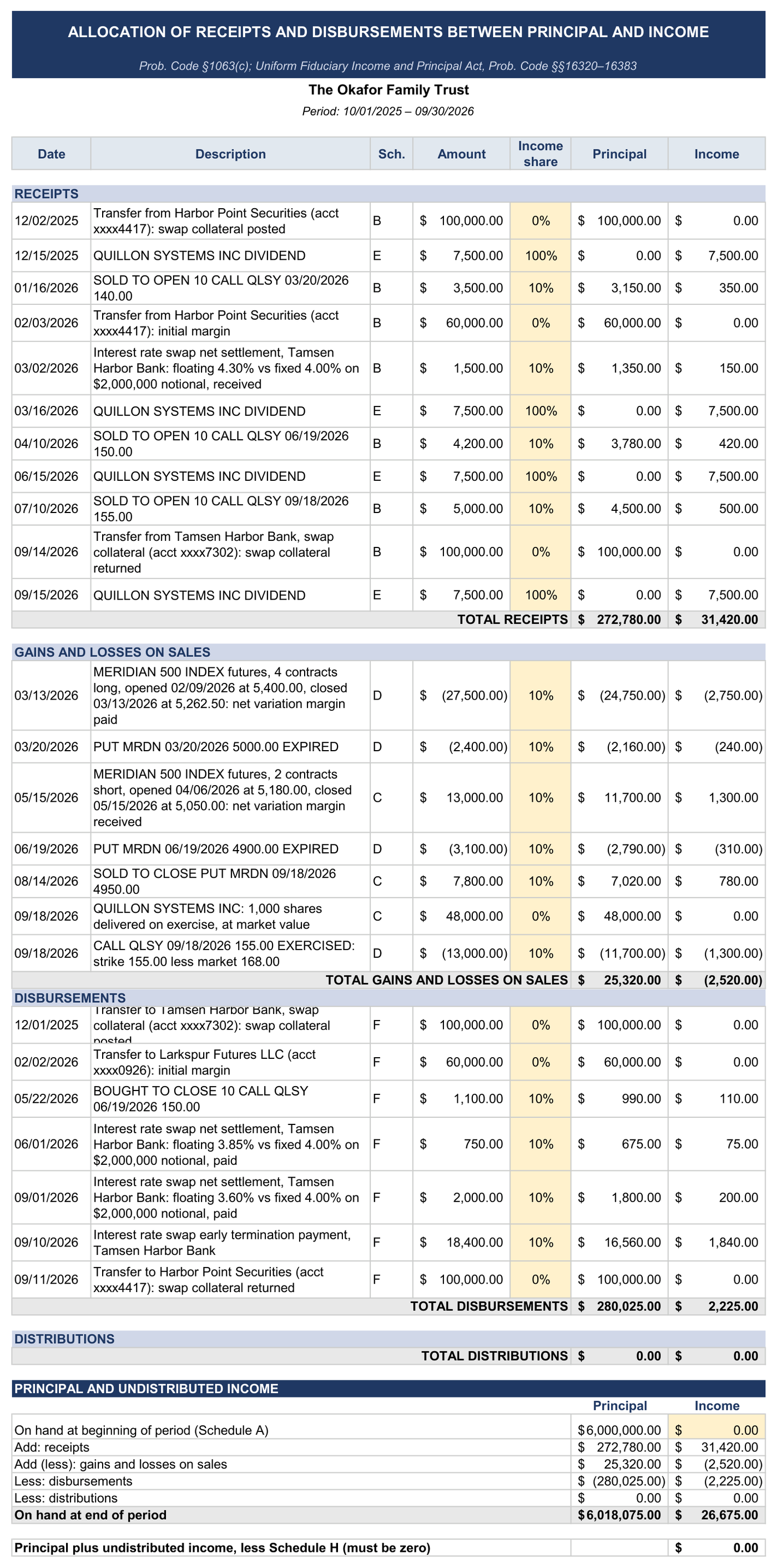
The facts above, as Balanced builds them: Daniel's covered calls, index puts, index futures and interest rate swap, in one fictional trust accounting, with each cash location reconciled and the 10 percent income share shown row by row. Select any sheet to see it full size.
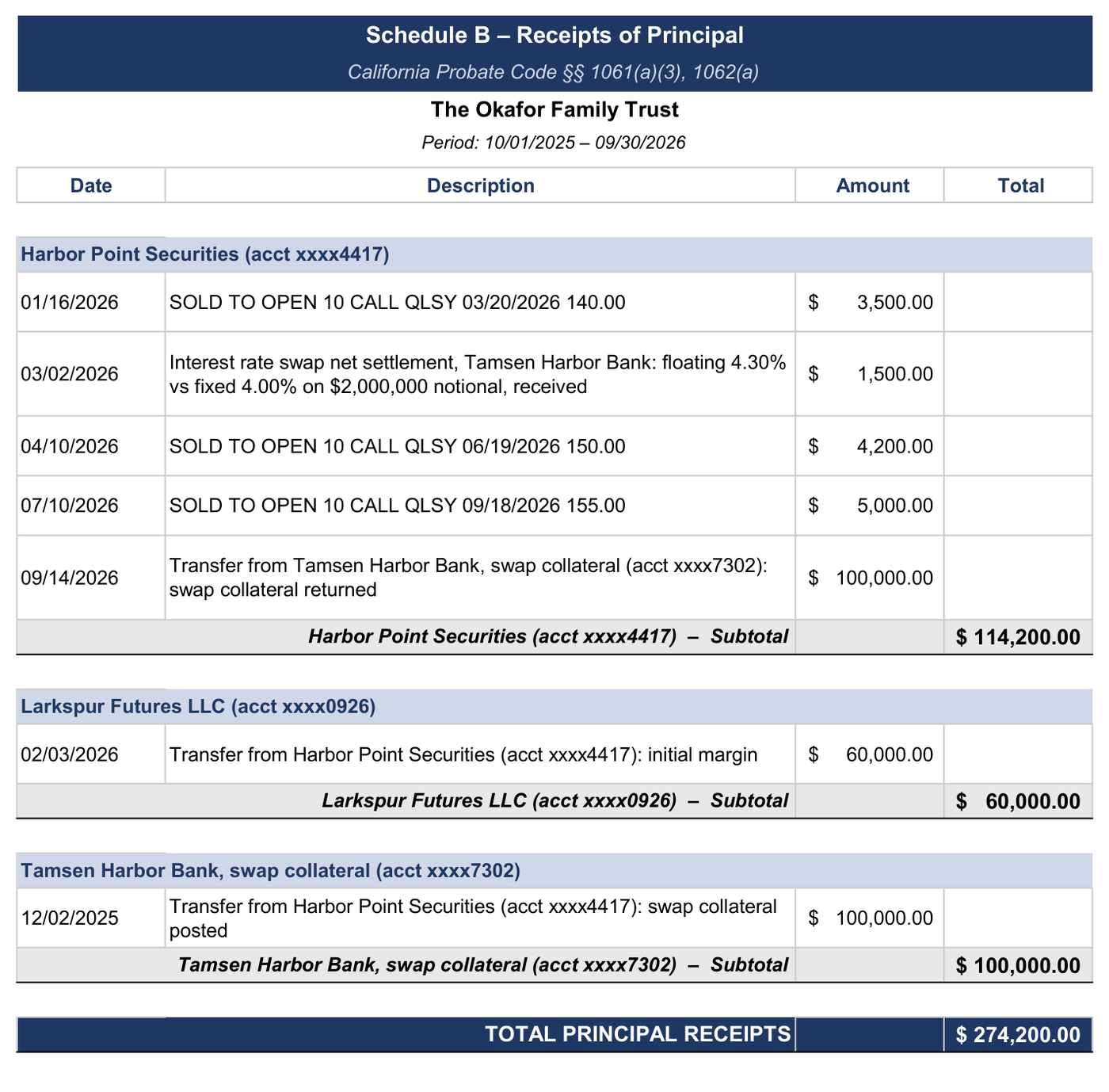
Schedule B: premiums and a swap payment received
Each covered call brought in its premium when it was written: $3,500, $4,200 and $5,000. The first expired worthless, so nothing more is entered for it. The $1,500 swap settlement received is here too, with its date and the bank. The transfers of margin and collateral are money moving between the trust's own accounts, not income.
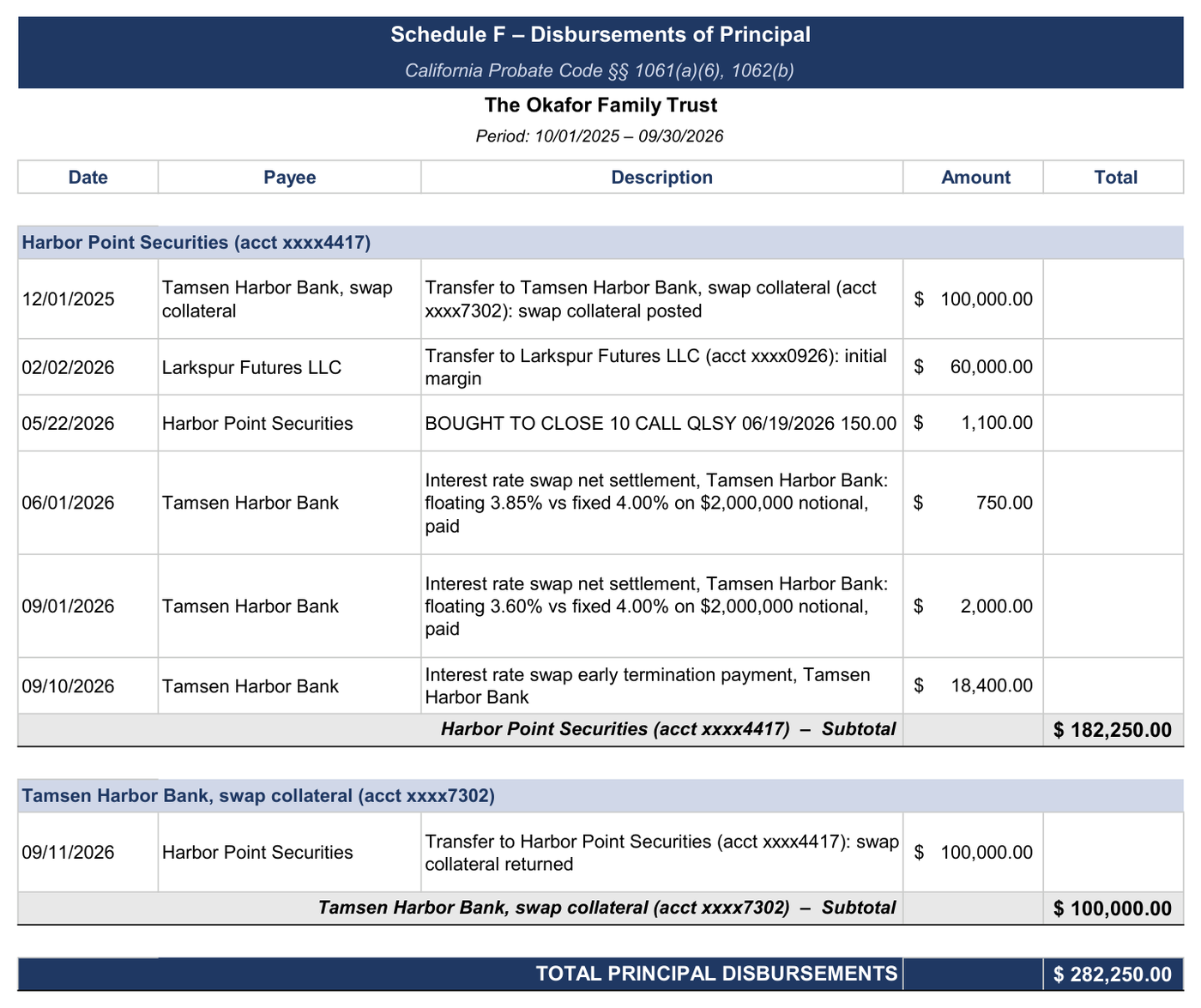
Schedule F: a call bought back, and the swap's payments
The call bought back before expiration cost $1,100. The swap's net payments of $750 and $2,000 and its $18,400 termination payment are each shown with date and bank. The note gives the swap's total result, $19,650 paid by the trust, and it is not repeated as a loss on Schedule D.
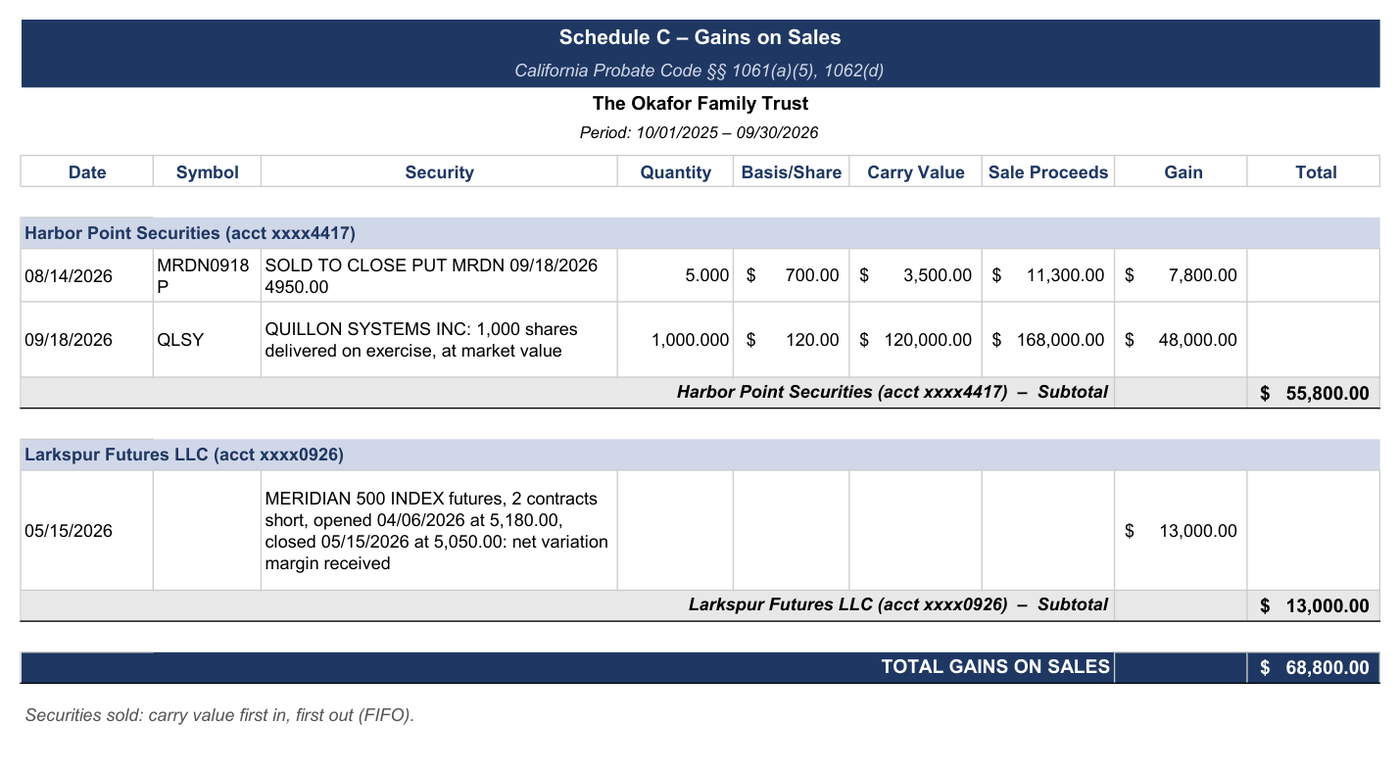
Schedule C: gains
The put sold after the market drop: carried at its $3,500 premium, sold for $11,300, a gain of $7,800. The 1,000 shares delivered on the exercised call, treated as sold at their $168,000 market value against a $120,000 carry value: a gain of $48,000. The short futures position, one line for the whole position: $13,000 net variation margin received.
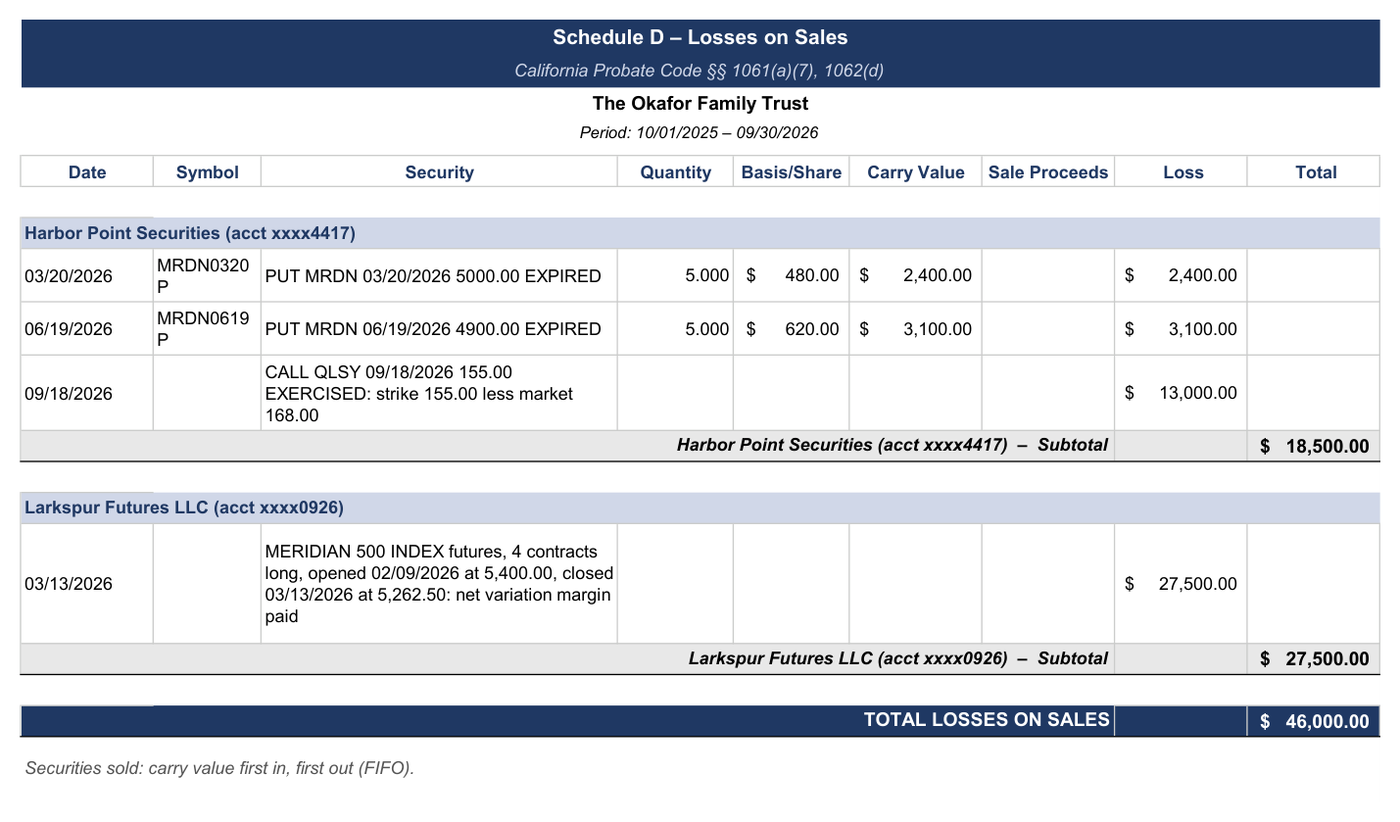
Schedule D: losses
Two puts expired worthless: losses of $2,400 and $3,100, the premiums paid. The exercised call's own result is the $155 strike less the $168 market value on 1,000 shares, a loss of $13,000. The long futures position lost $27,500 in net variation margin.
Principal and income: 10 percent to income
Every option, futures and swap row is split 10 percent to income and 90 percent to principal: $350, $420 and $500 of the premiums, $110 of the buy-back, $1,300 of the exercise loss, $780 of the put gain, $2,750 and $1,300 of the futures results, and $1,840 of the swap termination. The stock's $48,000 gain stays all principal. Income for the year is $26,675.
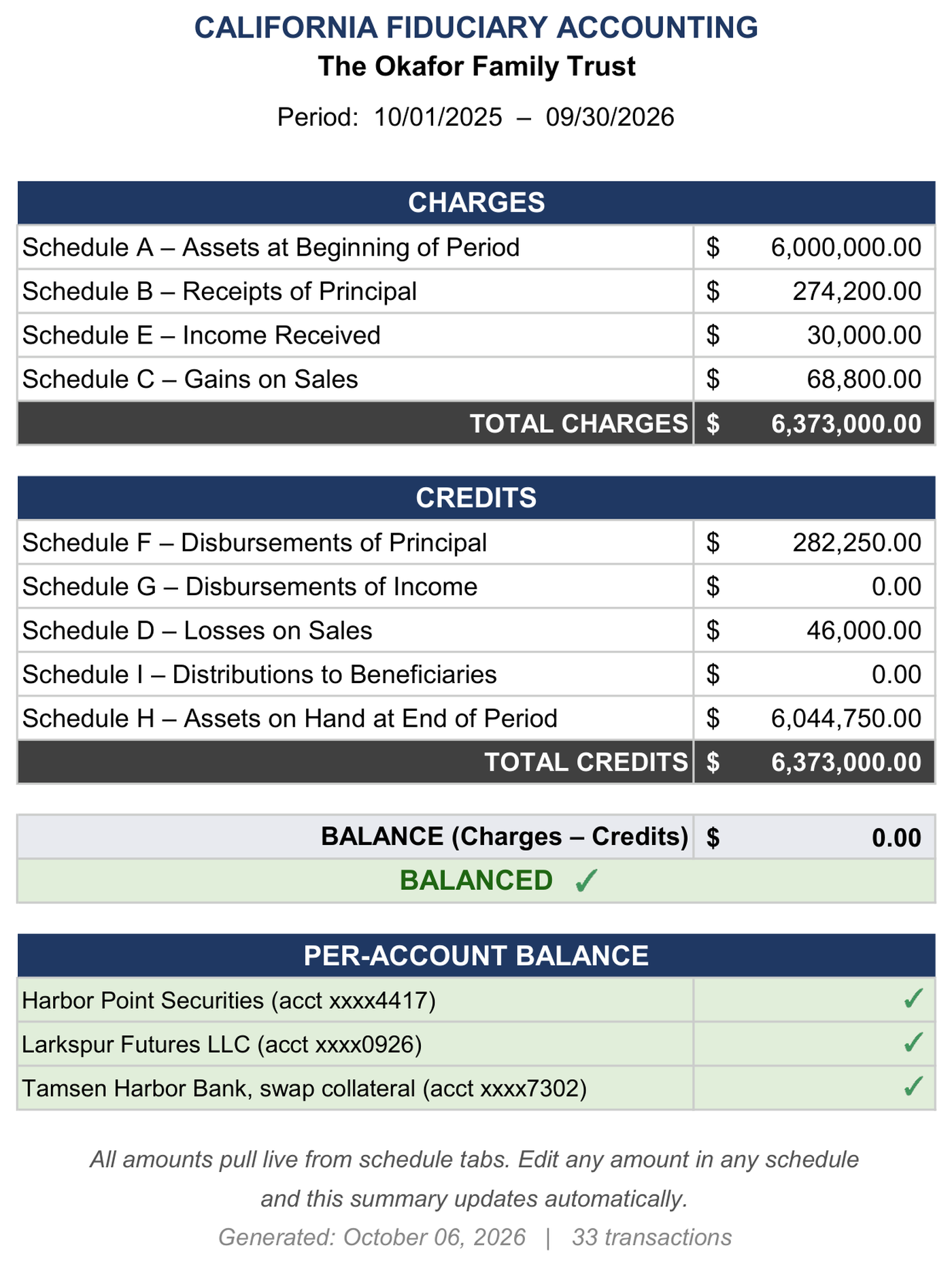
The summary
Charges and credits balance, and so does each location on its own: the brokerage account, the futures firm and the swap collateral account. The $45,500 still on deposit at the futures firm is trust property on hand at the end of the year.
Download the sample accounting (PDF)
Checklist
- Map and reconcile every cash location: brokerage, futures firm, swap collateral.
- Options carried at premium on the account; written options disclosed while open, as liabilities if open at period end (§ 1063(g)(5)).
- Each derivative cash amount allocated once, 10 percent income and 90 percent principal; no double allocation of premiums.
- Covered calls under § 16353(d); cash-settled index puts under § 16353(b).
- Exercised calls split between the stock (principal, § 16343(b)) and the option (§ 16353(d)(3)), with the method stated.
- Futures reported per position as net variation margin (§ 1062(d)), allocated under § 16353(b); margin on deposit as trust property.
- Swap payments and termination as receipts and disbursements under § 16353(b), not repeated as gains or losses; valuation by good-faith estimate (§ 1063(a)); negative value as a liability.
- Business treatment under § 16342 decided in advance, recorded and applied consistently.
- Strategy and results explained in numbers in the report (§ 1064(a)(2)).
The Law and the Art of Fiduciary Accounting is a series by Balanced Legal Technology, LLC on complex California fiduciary accountings. General information only, current as of October 2026; not legal, tax or accounting advice. Statutes and rules change; confirm current law before relying on it.
About the author
Marc Joyce is a licensed, practicing California trusts and estates attorney, and the founder and developer of Balanced. He brings both sides to the problem: as a lawyer, and as an engineer. The Law and the Art of Fiduciary Accounting is his series on the hard cases where the two meet.