
The facts
Dr. Samuel Whitcomb's trust pays all net income to his sister, Ruth, for life, then passes to a university. The trustee is a longtime family friend: not a beneficiary, not a relative, and not a professional. Dr. Whitcomb died on January 9, leaving a portfolio of about forty positions. In the twelve months that followed:
- A spin-off. An industrial conglomerate distributed one share of its new aerospace subsidiary for every four shares held. The trust received 312 new shares and $41.20 cash instead of a fractional share.
- A cash-and-stock merger. A regional bank the trust owned was acquired. For each share the trust received 0.85 share of the acquirer plus $9.00 in cash.
- A return of capital. A pipeline company organized as a partnership paid quarterly distributions, part of which it reported as a return of capital.
- A large special dividend. A retailer sold its credit card division and paid a special dividend of $38 per share. The trust's shares were worth about $140 each just before.
- Fund distributions. Two mutual funds paid ordinary dividends and capital gain distributions, all automatically reinvested, creating dozens of small new lots.
- A bond bought between coupons. The trustee bought a corporate bond on May 1. The bond pays interest every June 30 and December 31. The trustee paid the price plus four months of accrued interest.
- A dividend straddling the date of death. One company declared a dividend with a record date of January 5 and paid it on January 20.
The university's planned-giving office has asked for the account and will review it with outside counsel. Ruth needs to know her income. Nothing in this account is exotic, which is exactly why it is so often wrong.
Why this goes wrong
Brokerage statements are built for income tax reporting, not fiduciary accounting. They show the spin-off shares arriving with no explanation of value, the merger as a sale and a purchase, the return of capital mixed into "distributions," and the special dividend as ordinary income. A preparer who copies the statement inherits all of those errors. The two that matter most:
- Phantom charges. If the spin-off shares are entered as a receipt at market value, the account charges the trustee with value the trust did not receive. It received the same economic interest in two pieces.
- Misallocated income. If the special dividend goes to income, Ruth may receive principal that belongs to the university.
The law
The governing rule for corporate distributions. Money received in an entity distribution goes to income (Prob. Code § 16340(c)), subject to exceptions that send the following, among others, to principal (§ 16340(d)):
- "Property received in an entity distribution that is not money" (§ 16340(d)(1)).
- "Money received in an entity distribution that the fiduciary determines or estimates is a capital distribution" (§ 16340(d)(3)). A "capital distribution" is "A return of capital" or "A distribution in total or partial liquidation of the entity" (§ 16340(a)(1)).
- A capital gain dividend from "a regulated investment company or real estate investment trust" (§ 16340(d)(4)).
How the fiduciary decides. A fiduciary may determine or estimate whether a distribution is a capital distribution in several ways (§ 16340(e)):
- "By relying without inquiry or investigation on a characterization of the entity distribution provided by or on behalf of the entity," unless the fiduciary determines, on information known to it, that the characterization "is or may be incorrect" (§ 16340(e)(1), (e)(1)(A)).
- Where the money and property received "is, or will be, greater than 20 percent of the fair market value of the fiduciary's interest in the entity" (§ 16340(e)(2)).
- If neither applies, by weighing the factors the act lists (§ 16340(e)(3), (f)). And if the fiduciary concludes that part of a distribution is capital but is in doubt about how much, the amount in doubt goes to principal (§ 16340(g)).
Changes in form are principal. "Money or other property received from the sale, exchange, liquidation, or change in form of a principal asset" is principal (§ 16343(b)).
Interest. Interest goes to income "without provision for amortization of premium" (§ 16345(b)). The act has no rule for accrued interest paid when a bond is bought. That gap is addressed below.
Timing. For a trust that begins at a death, a receipt due before the date of death is principal (§ 16376(a)). An entity distribution is due "On the date fixed by or on behalf of the entity for determining the persons entitled to receive the distribution," which is the record date (§ 16376(f)(1)).
The account must show it. Every account includes a schedule of "purchases or other changes in the form of assets" (Prob. Code § 1063(b)) and a "Calculation of gains or losses on sale or other disposition" (§ 1062(d)). Because there is an income beneficiary, it also includes a schedule "showing an allocation of receipts and disbursements between principal and income" (§ 1063(c)).
Carry value is never defined. Property on hand is stated "at its carry value" (§ 1061(a)(10); § 1062(f)), but no section of the Probate Code defines the term. Carry value is a practice, not a formula: the value at which the fiduciary took the asset into the account, adjusted for what has happened since. Because the statute leaves the method open, the method must be consistent and must be explained.
The solution, event by event
1. The spin-off: split the carry value; do not add new value. The 312 aerospace shares are "Property received in an entity distribution that is not money," so they are principal (§ 16340(d)(1)). They are not a receipt that increases charges. The trust's existing carry value in the conglomerate is divided between the conglomerate shares and the new shares, and the transaction is reported on the changes in form schedule (§ 1063(b)).
How to divide it is the art. Issuers report the effect of a spin-off on their shareholders' tax basis, usually on IRS Form 8937, often as a percentage allocation between the old and new shares. Using the same allocation for carry value is, in our view, the most defensible method: it comes from the company, it can be checked, and it keeps the account consistent with the tax records. Where the issuer gives a method rather than a percentage, compute it and show the calculation. The $41.20 for the fractional share is a sale of a sliver of the new shares. Allocate a proportionate sliver of carry value to it and report the small gain or loss (§ 1062(d)).
2. The cash-and-stock merger: one exchange, one decision about carry value. Surrendering bank shares for acquirer shares plus cash is a "change in form of a principal asset." Everything received, both the stock and the cash, is principal (§ 16343(b)). The $9.00 per share is not income for Ruth, however the brokerage statement labels it.
The statute does not say how to carry the new shares, and two methods are defensible:
- Treat the whole exchange as a disposition. Report a gain or loss equal to the cash plus the market value of the new shares, less the carry value of the old shares. The new shares then take their market value at the merger date as carry value.
- Carry the investment forward. Allocate the old carry value between the cash and the new shares in proportion to their values. Report a gain or loss only on the cash portion, and carry the new shares at the remainder.
The first is simpler to read. The second keeps more of the investment's history in the carry value, though it will not match the tax result, which follows its own rules for cash received in a reorganization. Choose one, apply it to every merger in the account, and state it in the report (§ 1064(a)(1)).
3. Return of capital: principal, but test the label. The portion of each distribution the company reports as a return of capital is a capital distribution, so it is principal (§ 16340(a)(1)(A), (d)(3)). The balance is income (§ 16340(c)).
Here the trustee should be careful about relying on the label. For a partnership-structured pipeline company, "return of capital" is largely a tax characterization driven by depreciation, and it can cover most of a distribution paid out of operating cash. That is the situation in which a fiduciary may know a characterization "is or may be incorrect" (§ 16340(e)(1)(A)), and Ruth's counsel will press the point. The split is also often known only after year end. The act addresses later information: information received before payment may change the decision (§ 16340(h)); after payment, there is no duty to change or recover the payment, but the information may be considered in using the power to adjust (§ 16340(i)).
How a return of capital affects carry value is a method choice. Our practice is to reduce the investment's carry value by the amount returned and to report a gain only if cumulative returns exceed it, which mirrors the tax treatment and keeps the records aligned. Whatever method is chosen, state it.
4. The special dividend: the 20 percent test supports principal. $38 against a share worth about $140 is roughly 27 percent of the fair market value of the trust's interest. That exceeds the 20 percent threshold, so the trustee may treat the dividend as a capital distribution (§ 16340(e)(2)), and the facts support doing so: the money came from selling a division, a partial liquidation in substance (§ 16340(a)(1)(B), "partial liquidation of the entity"). Allocate it to principal.
Ruth will see "dividend" on the statement. The account must explain, in plain terms, why a payment the company called a dividend is principal under the statute. This is a decision the trustee makes, supported by the arithmetic and the company's own announcement of the sale.
5. Mutual funds: capital gain distributions to principal, and watch the reinvestment. Capital gain dividends from a mutual fund are principal (§ 16340(d)(4)). Ordinary fund dividends are income (§ 16340(c)). Note that a fund's short-term capital gain distributions are generally reported as ordinary dividends, not capital gain dividends, and so follow the income rule.
Automatic reinvestment creates a trap. When an ordinary dividend is reinvested, income cash buys new fund shares, which then sit in the portfolio alongside principal. Unless the account tracks it, income owed to Ruth has silently become principal. Show each ordinary dividend as an income receipt, show the reinvestment as a purchase on the changes in form schedule (§ 1063(b)), and carry the reinvested lots so the principal and income schedule (§ 1063(c)) shows that income was invested, not lost. The cleaner practice for a trust with an income beneficiary is to turn reinvestment off.
6. The bond bought between coupons: the gap in the act. On May 1 the trustee paid four months of accrued interest to the seller. On June 30 the bond paid six months of interest. Section 16345(b) allocates to income "an amount received as interest," and read literally it sends the whole coupon to Ruth, including the four months that principal paid for in May.
That is a real gap. Principal paid for the accrued interest, so treating all of it as Ruth's income transfers value from the university to her. A defensible approach:
- Record the accrued interest paid at purchase as part of the cost of the investment, an asset of principal.
- When the coupon arrives, treat the purchased portion as a recovery of that cost, which is principal, and only the interest earned while the trust held the bond as income.
Because this departs from the literal reading of section 16345(b), explain it in the report and consider documenting it as an adjustment under the power to adjust (§ 16327(a)). That power is available unless the trust instrument expressly denies or limits it (§ 16327(i)). It is also unavailable if "The fiduciary is not an independent person" (§ 16327(e)(7)). A family friend who is not a beneficiary, a relative or an employee of one will ordinarily qualify as independent, but confirm it against the act's definition, which also excludes the settlor and certain others (§ 16321(k)), and note that where the limit applies, the act provides alternatives such as a cofiduciary (§ 16327(f)). Adjustments must be described to the beneficiaries (§ 16327(k)).
A related rule is not a gap. A bond bought at a premium declines to par by maturity. The act allocates interest "without provision for amortization of premium" (§ 16345(b)), so the full coupon is income and principal absorbs the loss at maturity. Show that loss on the losses schedule when it occurs, and say why.
7. The dividend that straddles death: the record date controls. The dividend with a January 5 record date was due on January 5, before Dr. Whitcomb died on January 9 (§ 16376(f)(1)). Although it was paid on January 20, it is principal (§ 16376(a)). It belongs on the beginning schedule of property on hand as a receivable at death, or as a principal receipt with an explanation, not in Ruth's income.
Tracking lots through it all
By year end, one original position may have become a dozen lots: the conglomerate and its spin-off, the acquirer shares from the merger, and two funds with monthly reinvestments. Each lot needs a carry value that can be traced back to the date-of-death value through every event above. That traceability is what makes the account defensible. The gains and losses schedule (§ 1062(d)) is only as good as the carry values behind it, and a reviewer can test any one of them by following its history.
The sample accounting
The facts above, as Balanced builds them: all seven events in Dr. Whitcomb's trust, from the spin-off to the dividend paid after his death. To keep it readable, the sample holds only the positions those events touch, not all forty. Select any sheet to see it full size.
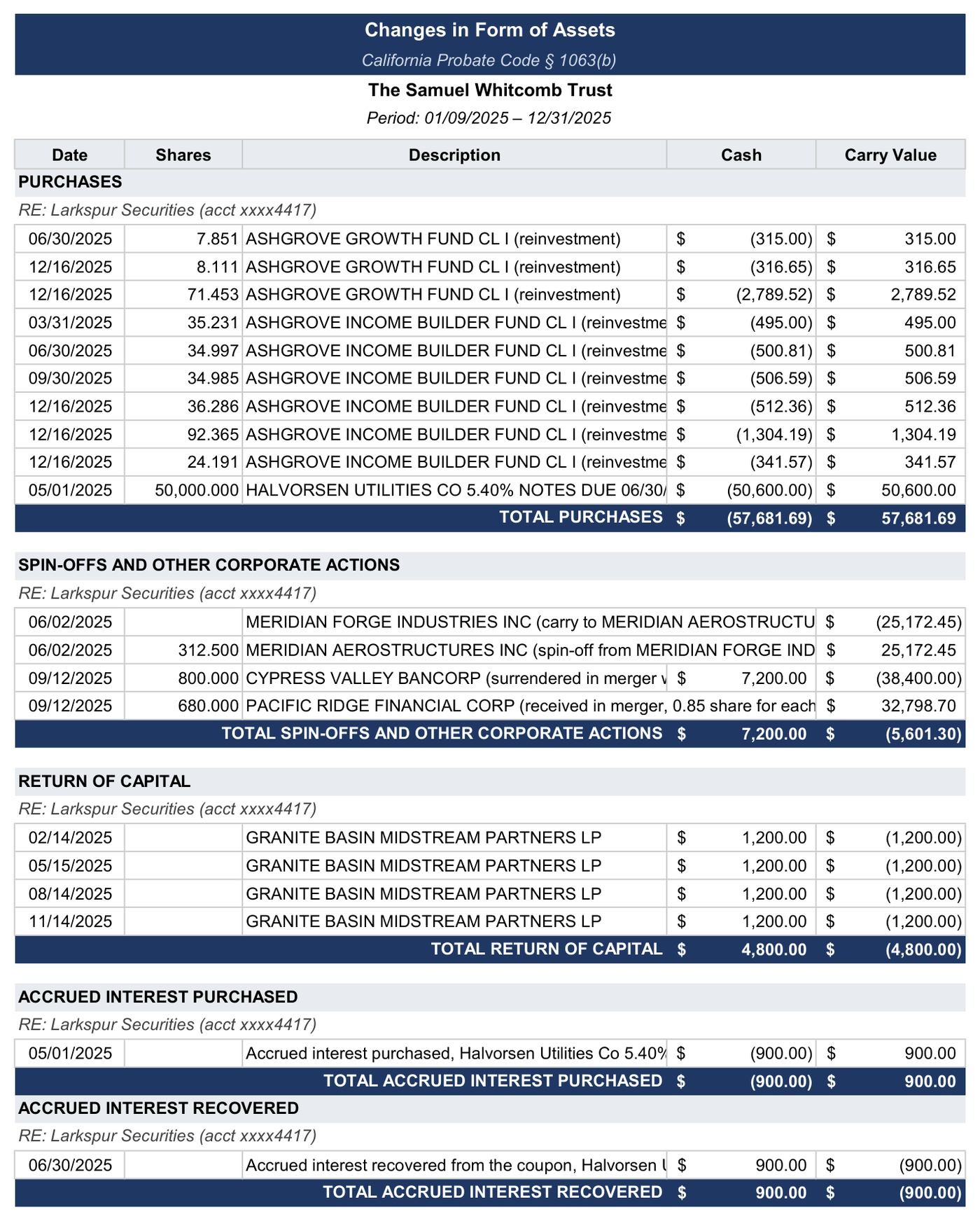
Changes in form: the spin-off, the merger, returns of capital, accrued interest
The spin-off adds no value: $25,172.45 of the conglomerate's carry, per the issuer's Form 8937, moves to the new shares. The merger carries the investment forward: $5,601.30 of the bank's $38,400 carry goes with the $7,200 cash, and the 680 new shares carry the rest, $32,798.70. Each $1,200 the partnership reported as a return of capital reduces its carry. The $900 of accrued interest paid with the bond is principal's investment, returned from the June coupon.
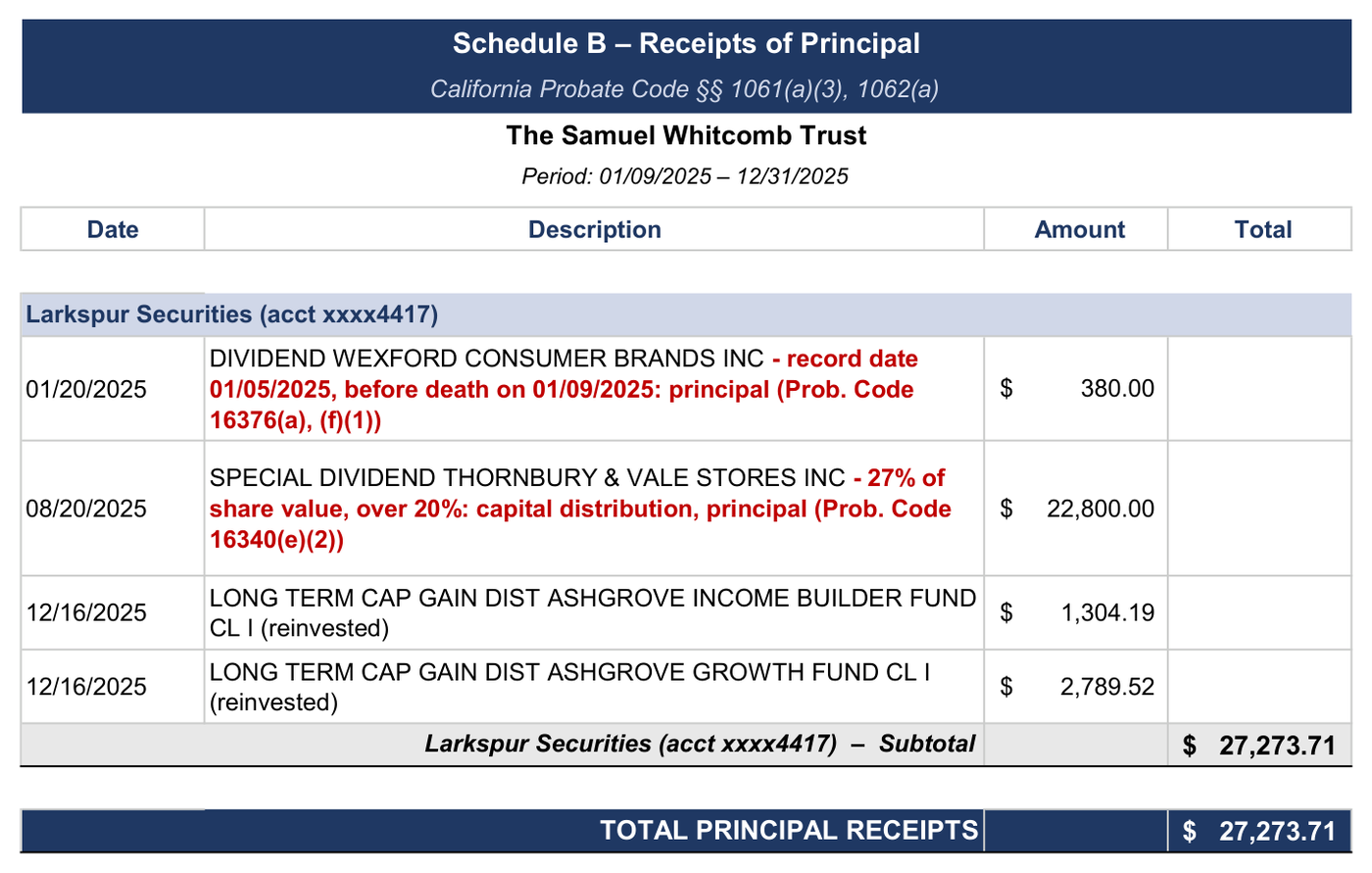
Schedule B: principal receipts
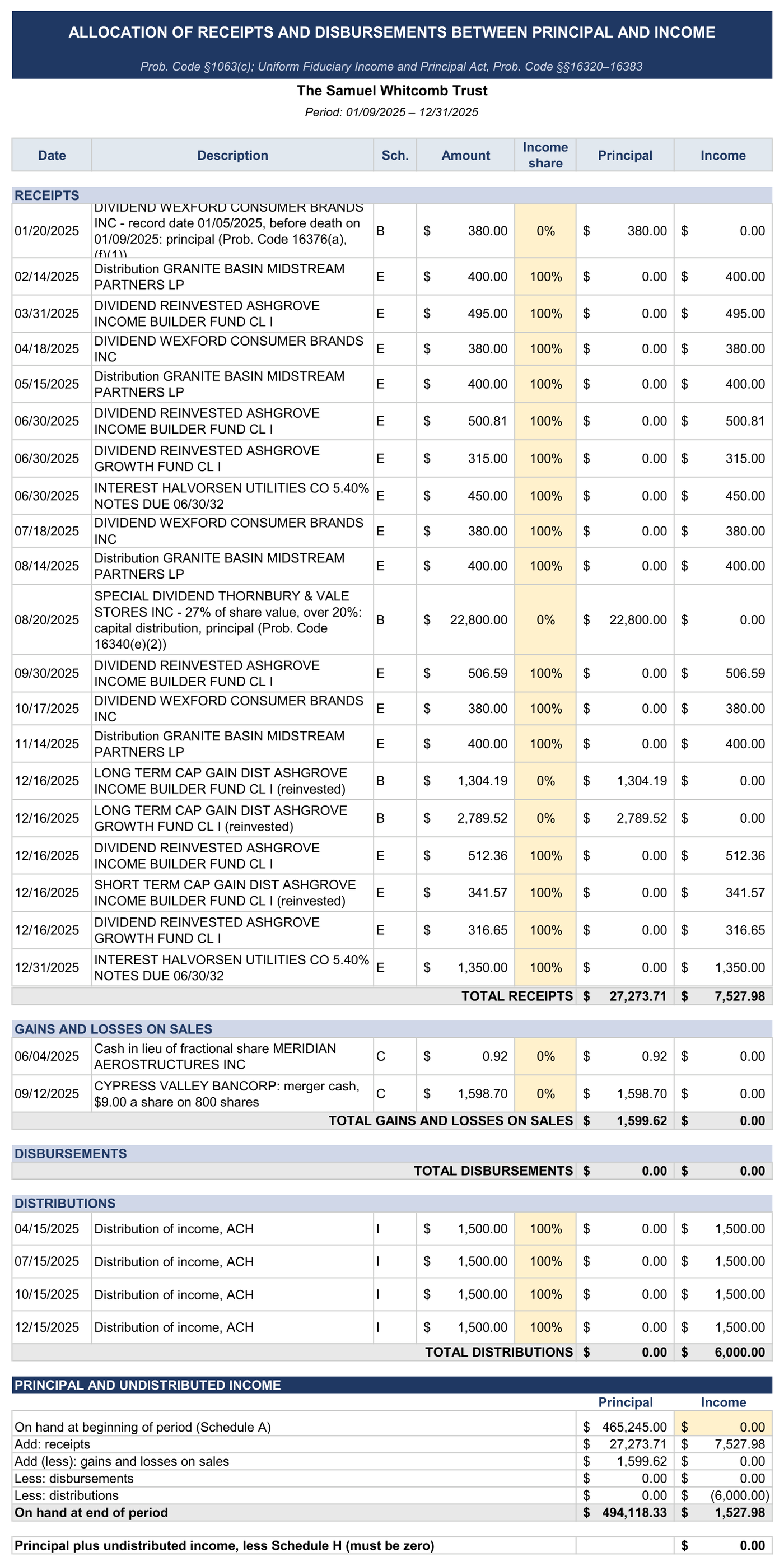
The $22,800 special dividend is principal: $38 is about 27 percent of a share worth about $140, over the 20 percent test. The $380 dividend with a January 5 record date is principal too, though paid after death. Fund capital gain distributions are here, as principal.
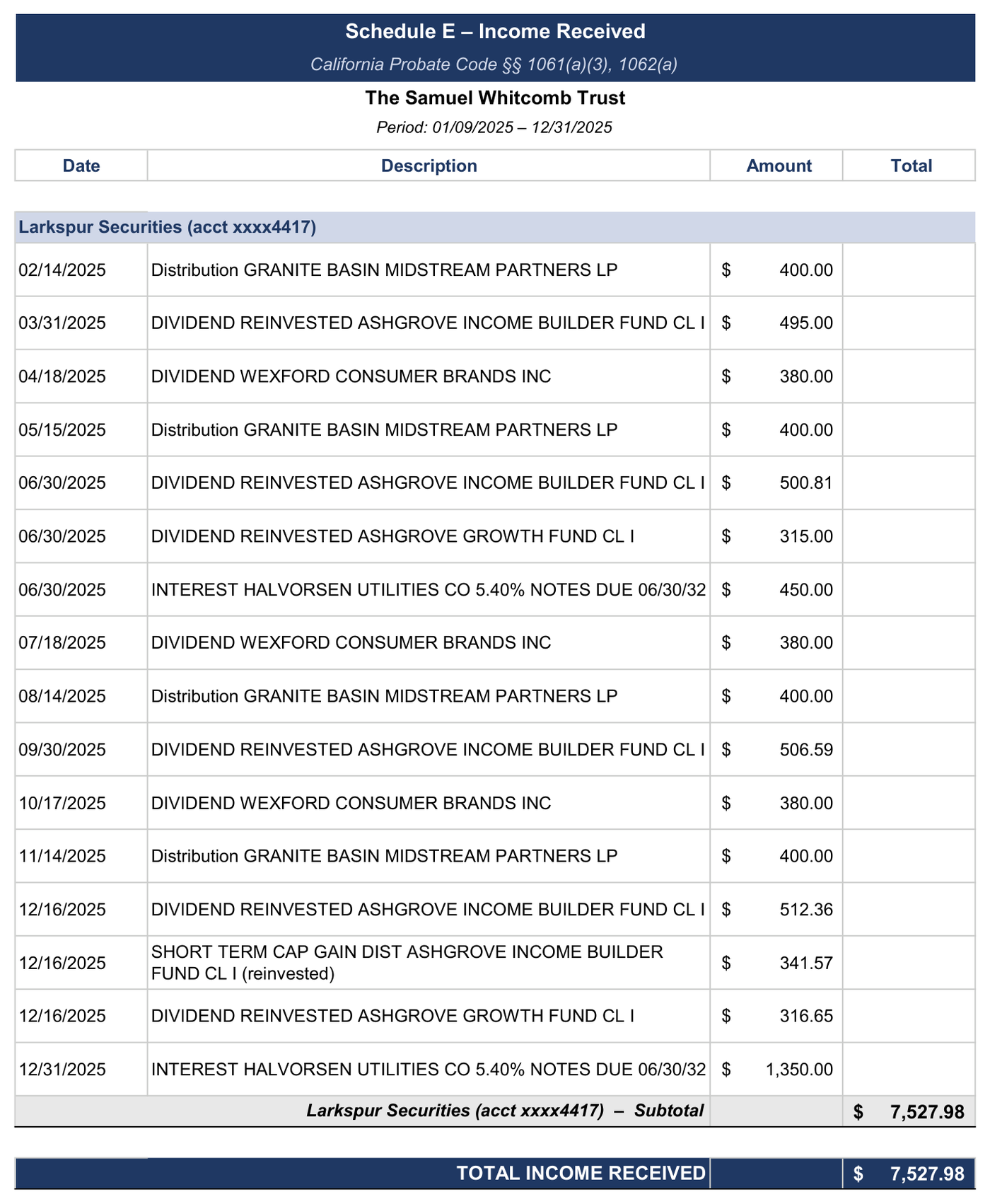
Schedule E: Ruth's income
Ordinary fund dividends and the short-term gain distribution are income, though reinvested. The $900 of accrued interest paid with the bond was principal's investment, so the June coupon returns it to principal and only $450 of that coupon is income: of the $2,700 in coupons, Ruth receives $1,800, the interest earned while the trust held the bond.
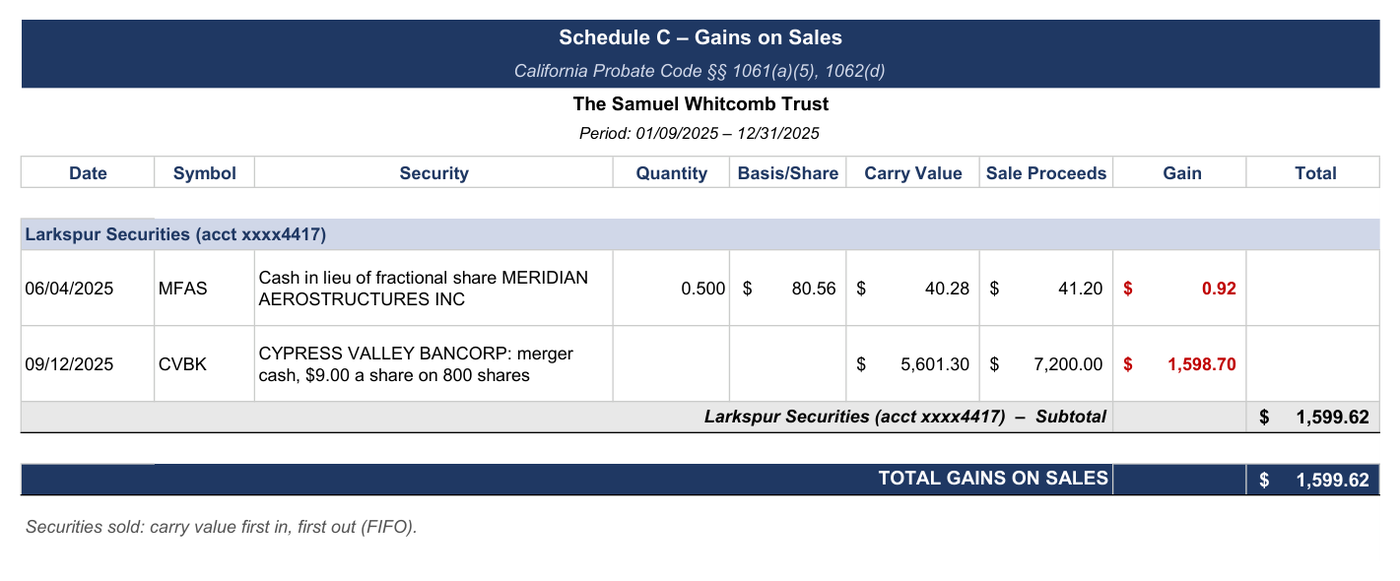
Schedule C: the two small gains
The $41.20 for the half share carries $40.28 of the new shares' carry, a gain of $0.92. The merger's gain is on the cash only: $7,200 less $5,601.30, or $1,598.70.
Principal and income
Every receipt, sorted between Ruth and the university, with the section it rests on. Ruth's income for the year is $7,527.98; $6,000 was paid to her and $1,527.98 remains undistributed.
Schedule H: carry values at year end
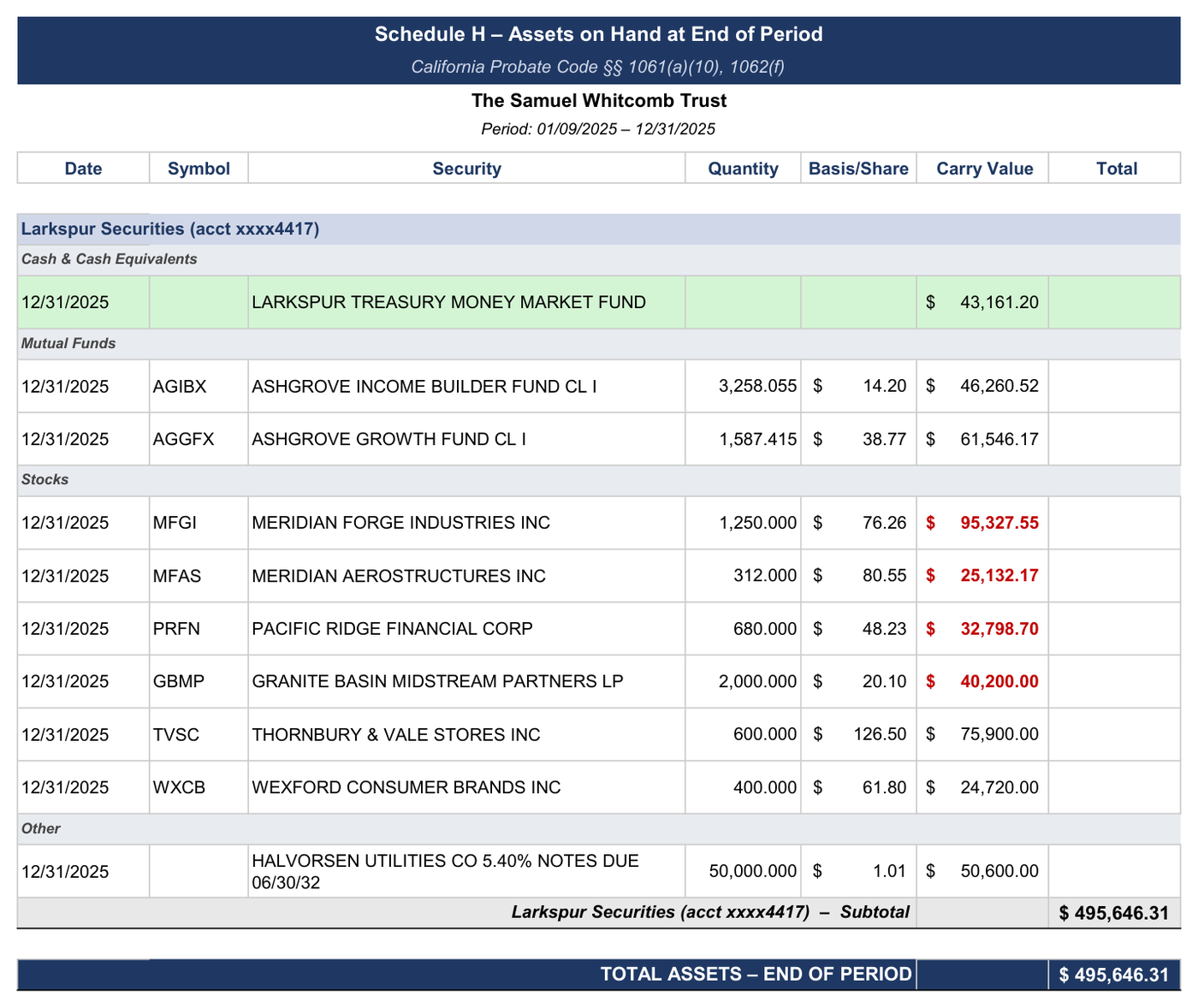
Each holding's carry traces back to the date of death: the conglomerate at $95,327.55 after the spin-off, the partnership at $40,200 after $4,800 of returns of capital, and each fund at its opening carry plus every reinvested distribution.
Download the sample accounting (PDF)
Checklist
- Spin-off shares to principal (§ 16340(d)(1)); carry value divided using the issuer's published allocation; reported as a change in form (§ 1063(b)).
- Merger stock and cash to principal (§ 16343(b)); one carry-value method, stated and applied consistently.
- Return of capital to principal (§ 16340(d)(3)), with the label tested for a partnership issuer (§ 16340(e)(1)(A)); carry-value method stated.
- Special dividends tested against the 20 percent rule (§ 16340(e)(2)).
- Fund capital gain dividends to principal (§ 16340(d)(4)); reinvested income tracked in the principal and income schedule (§ 1063(c)).
- Purchased accrued interest addressed and explained; bond premium not amortized (§ 16345(b)).
- Receipts due before death, by record date, to principal (§ 16376(a), (f)(1)).
- Every method that the statute leaves open, stated in the report (§ 1064(a)(1), (2)).
The Law and the Art of Fiduciary Accounting is a series by Balanced Legal Technology, LLC on complex California fiduciary accountings. General information only, current as of October 2026; not legal, tax or accounting advice. Statutes and rules change; confirm current law before relying on it.
About the author
Marc Joyce is a licensed, practicing California trusts and estates attorney, and the founder and developer of Balanced. He brings both sides to the problem: as a lawyer, and as an engineer. The Law and the Art of Fiduciary Accounting is his series on the hard cases where the two meet.