
A complete accounting, schedule by schedule
This is a complete sample accounting for a fictional trust, The Hartwell Family Trust, generated by Balanced: a checking account and a brokerage account, a rental property, an income beneficiary, and twelve months of activity. The trust, the people and the account numbers are made up. It follows the court format of California Probate Code §§1060–1064, which applies to trust accountings filed with the court. Click any schedule to see the whole sheet.
Download the sample accounting (PDF)
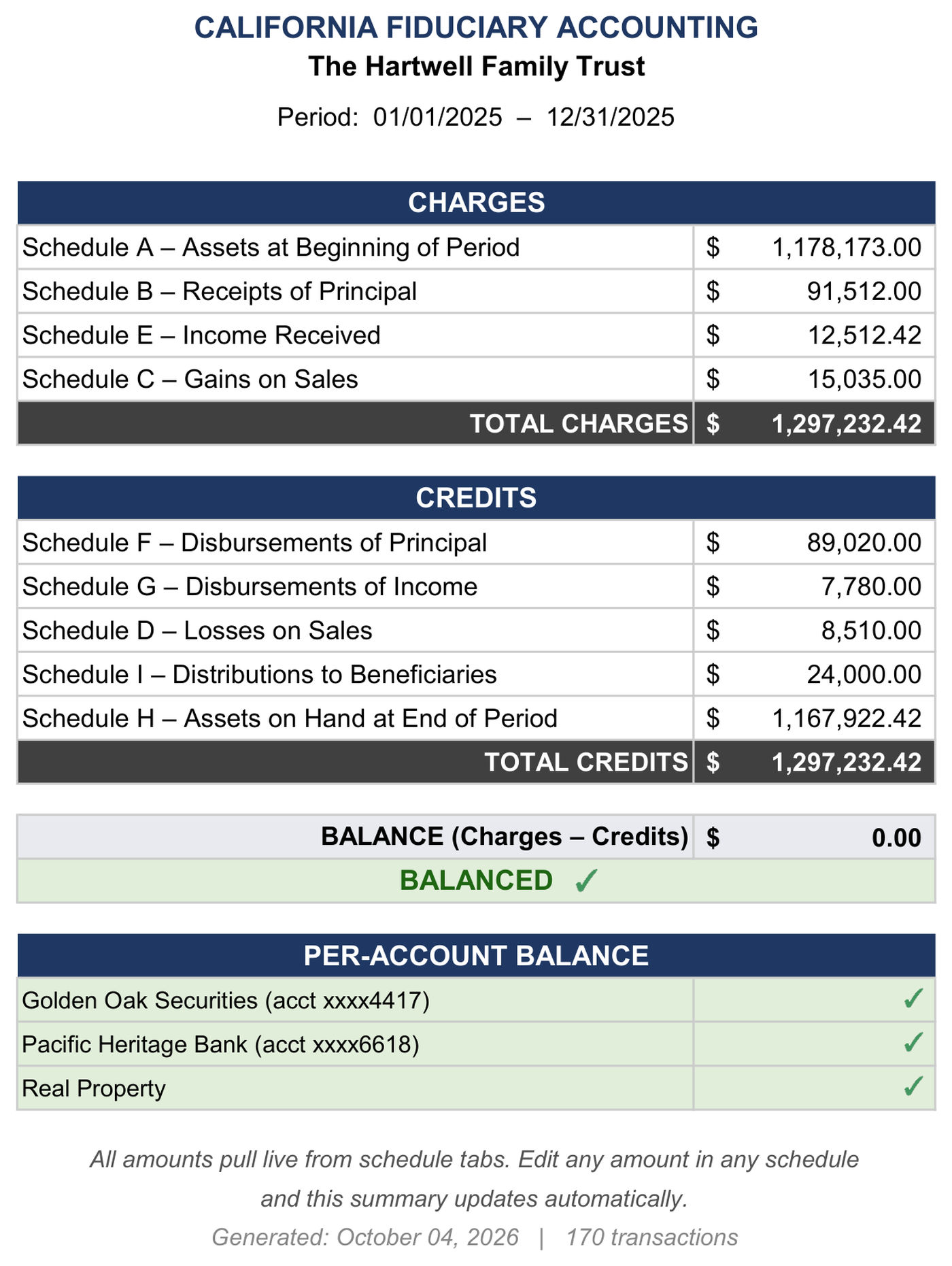
The summary of account
The charges (what the fiduciary started with and received) against the credits (what was paid out, distributed or is still on hand). Under Probate Code §1061(c) the two totals must be equal; the balance line shows zero. Each line pulls its total from its schedule.
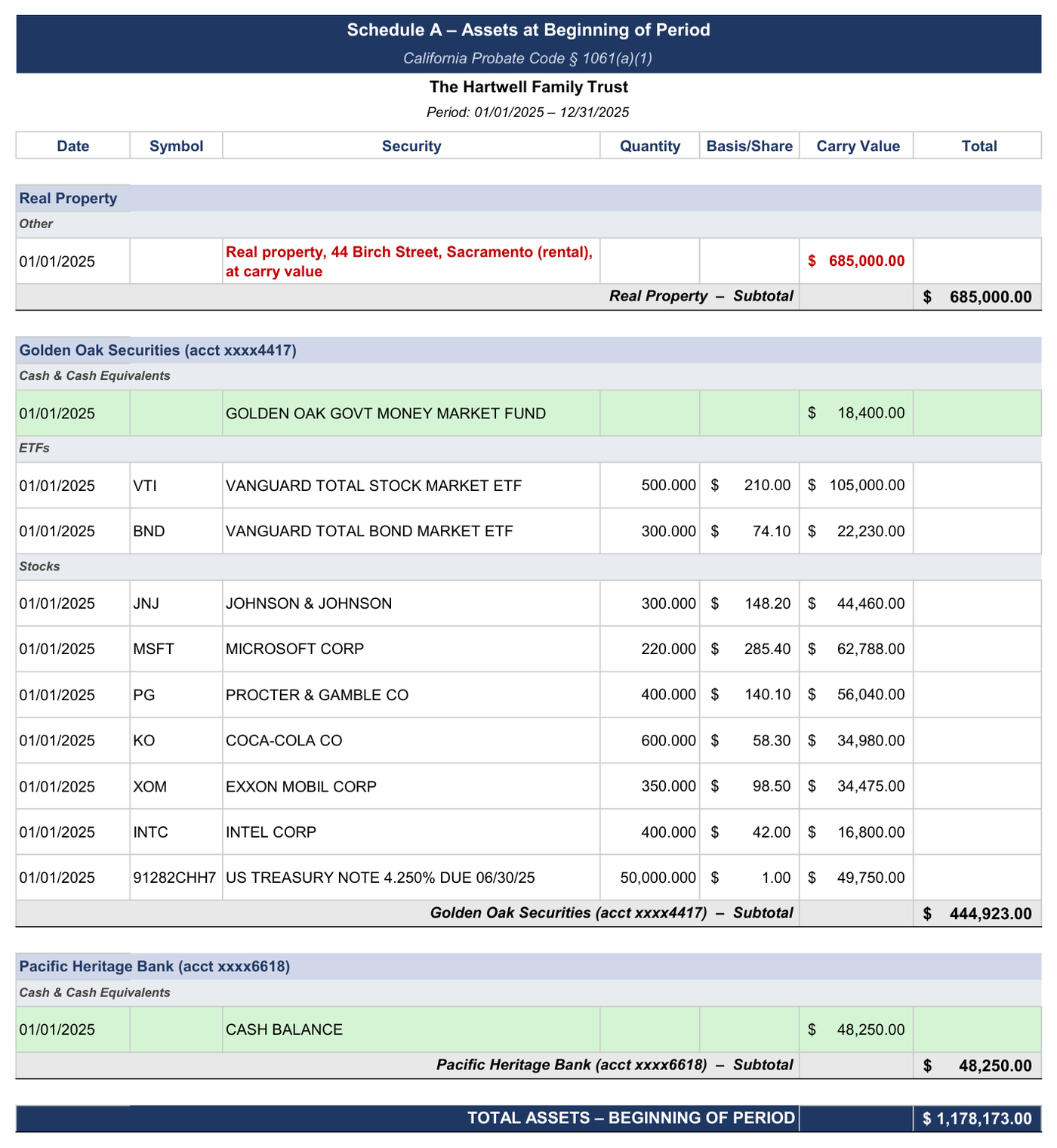
Schedule A: property on hand at the beginning
Every asset on hand on the first day of the period, account by account, at carry value (§1061(a)(1)). For a later account it is the prior account’s Schedule H.
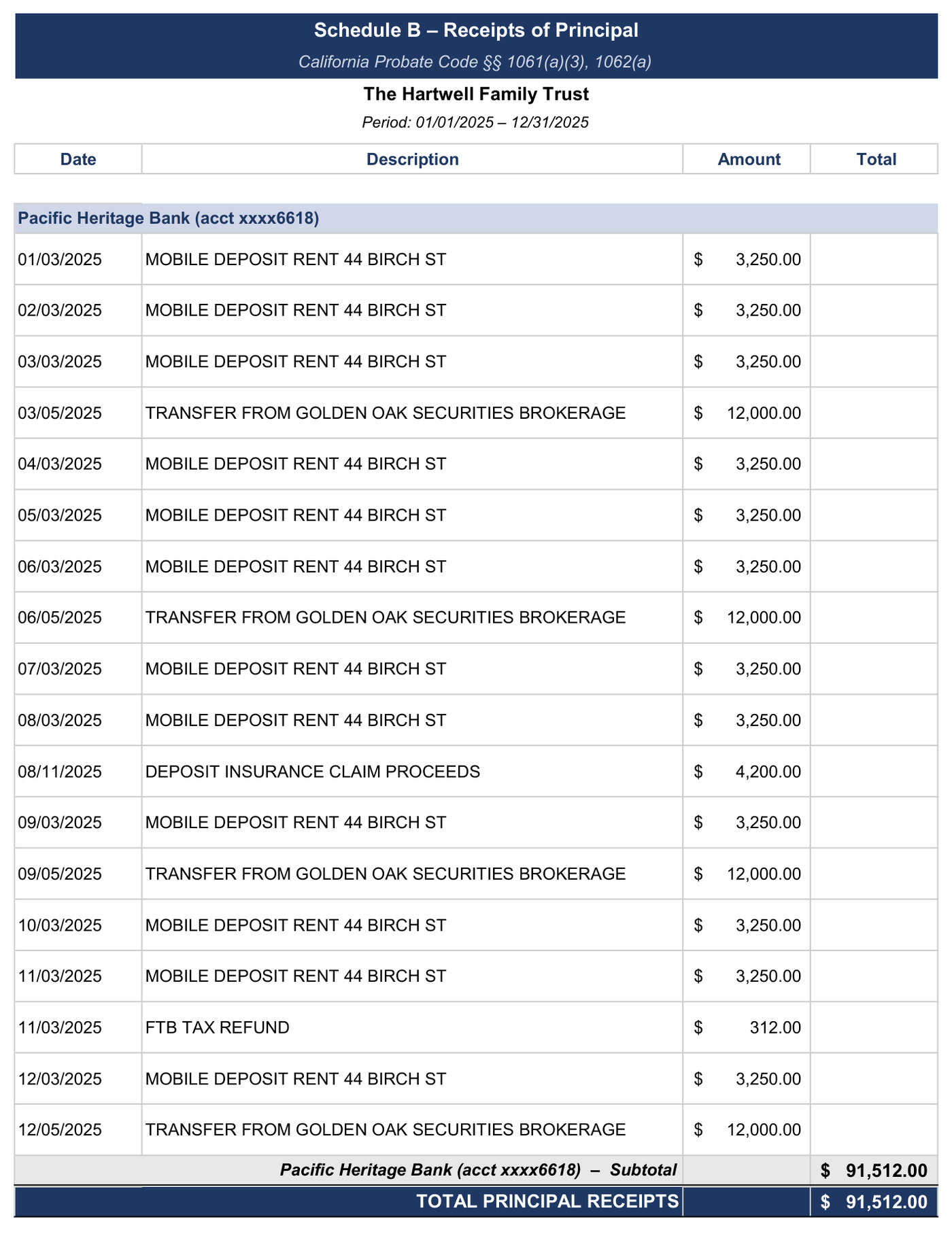
Schedule B: receipts of principal
Each receipt of principal with its nature or purpose, source and date (§§1061(a)(3), 1062(a)).
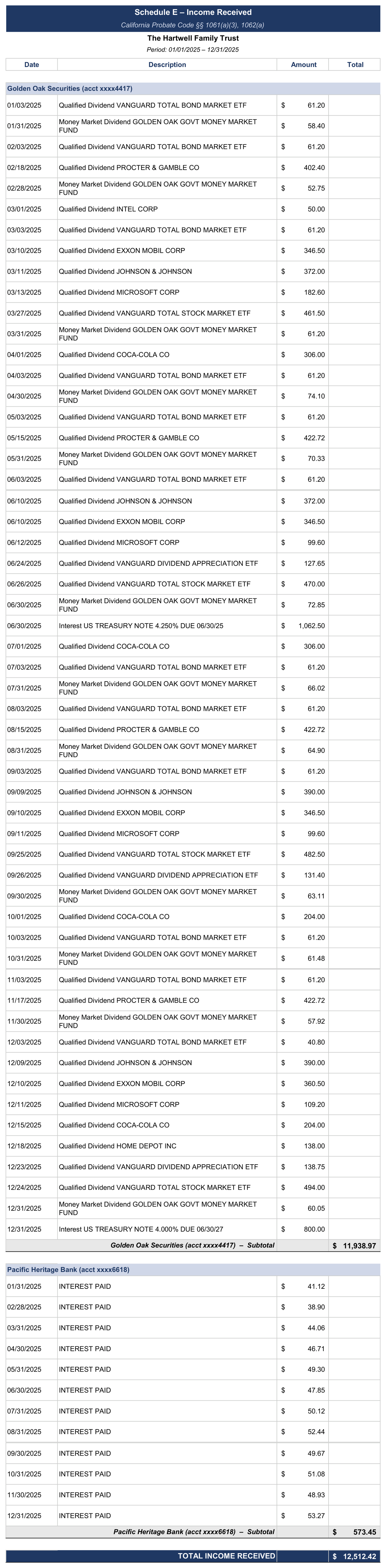
Schedule E: income received
Each dividend, interest payment and other income receipt, with its source and date (§§1061(a)(3), 1062(a)).
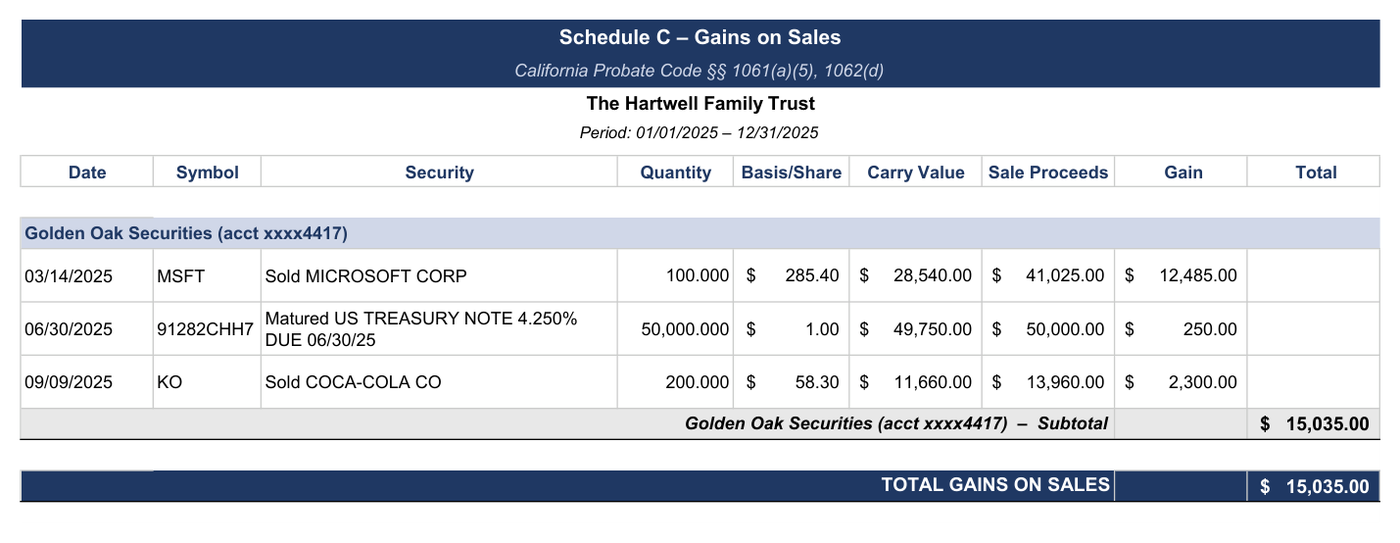
Schedule C: gains on sales
Each sale or other disposition that produced a gain, calculated from carry value (§§1061(a)(5), 1062(d)).
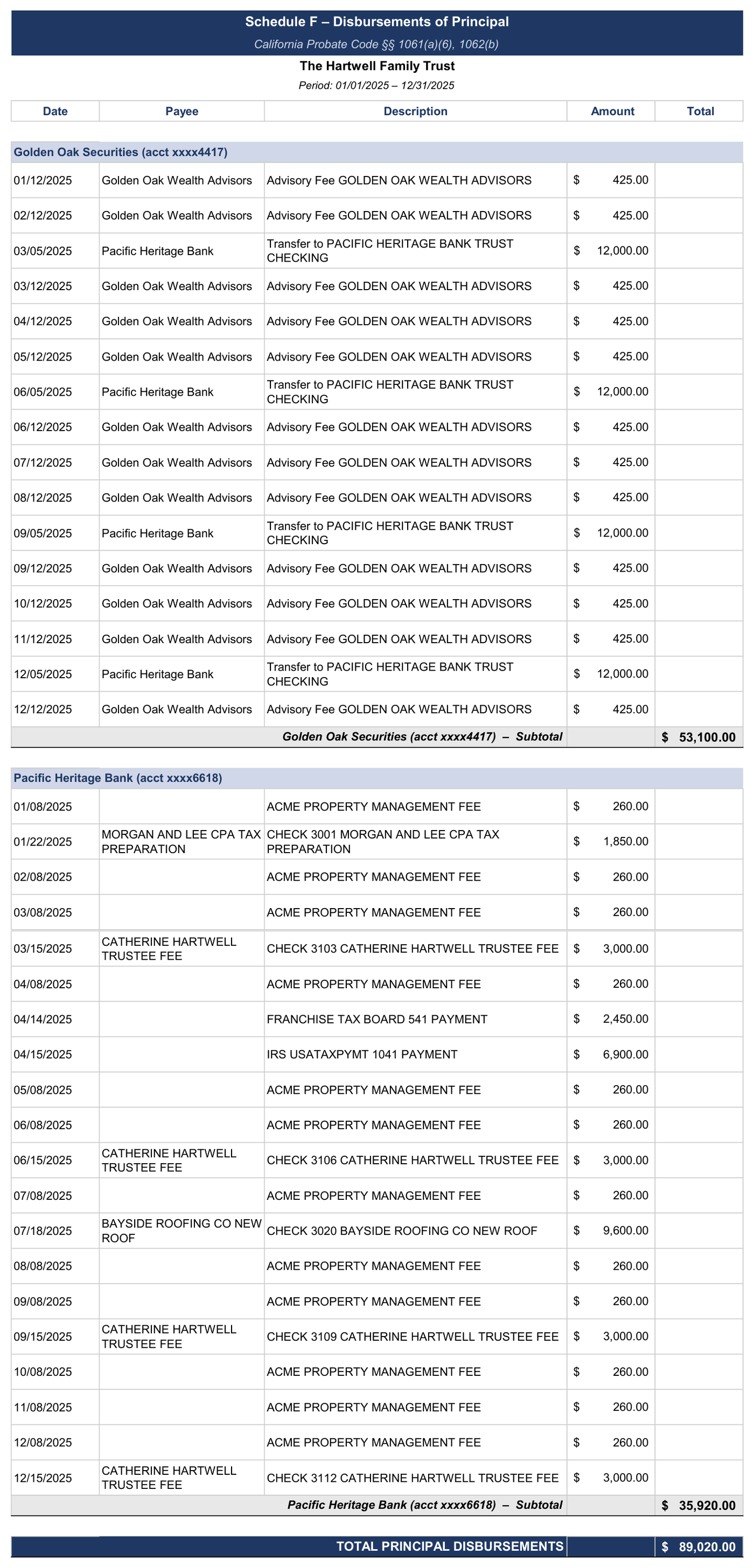
Schedule F: disbursements of principal
Each disbursement with its nature or purpose, payee and date (§§1061(a)(6), 1062(b)).
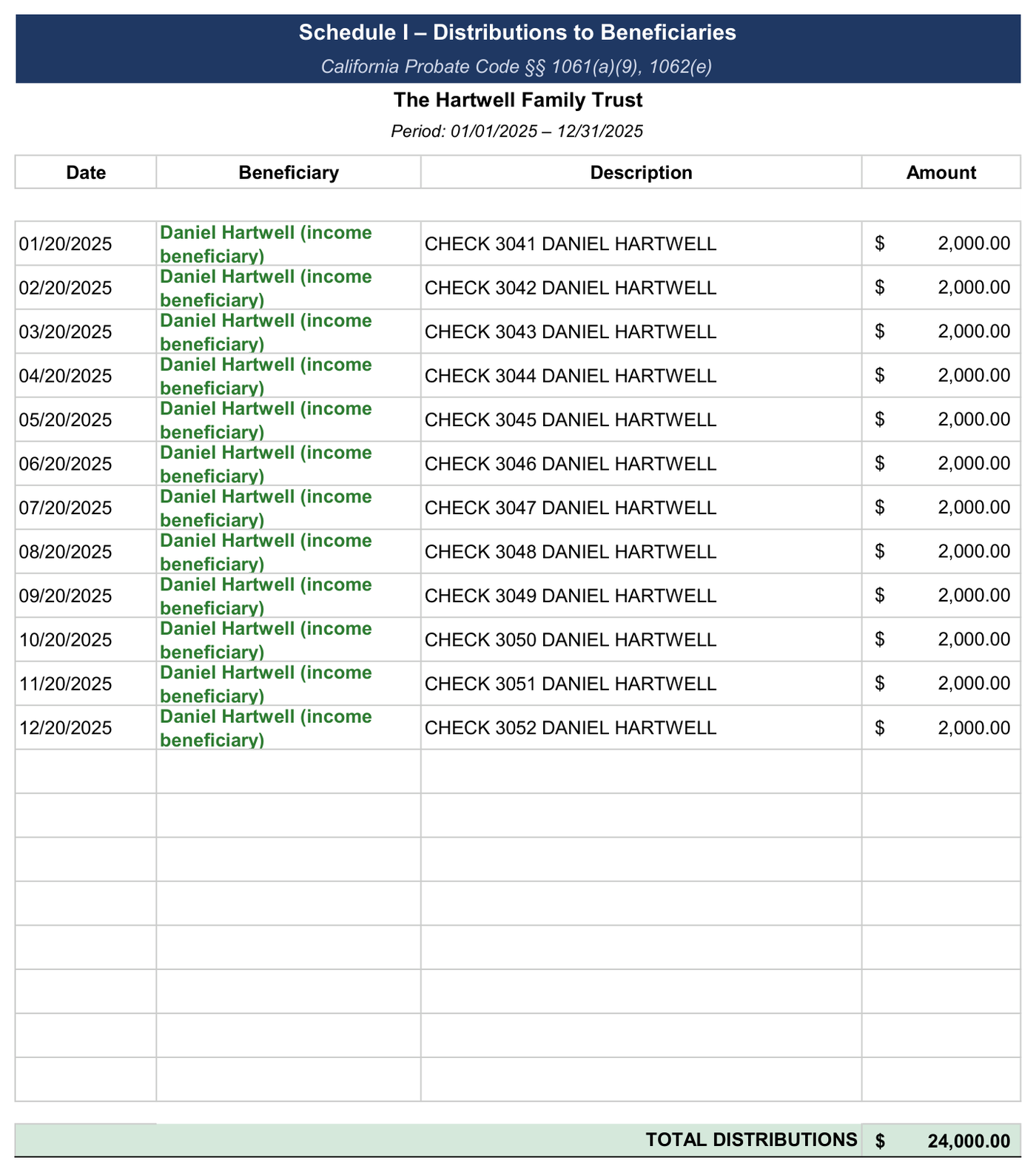
Schedule I: distributions
Each distribution of cash or property to a beneficiary, with the date and amount, property at carry value (§§1061(a)(9), 1062(e)).
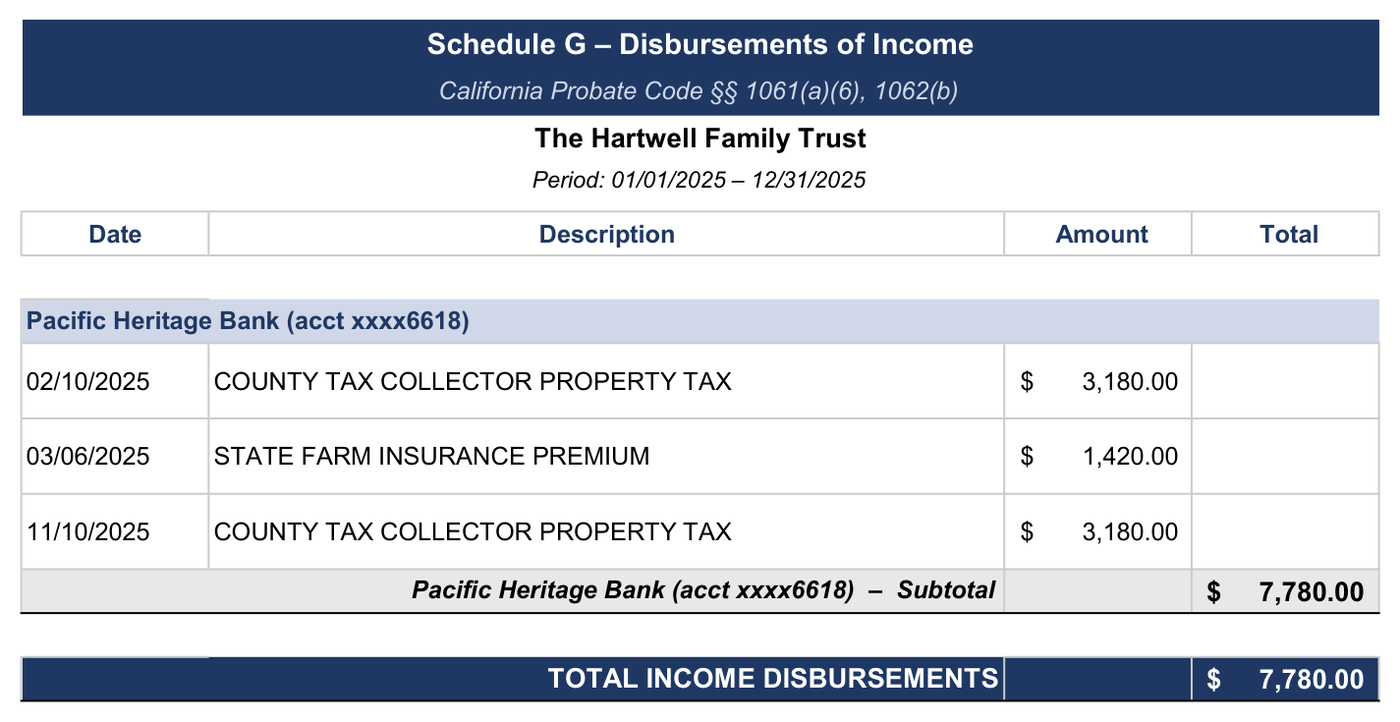
Schedule G: disbursements of income
Disbursements charged to income rather than principal, with the same detail (§§1061(a)(6), 1062(b)).
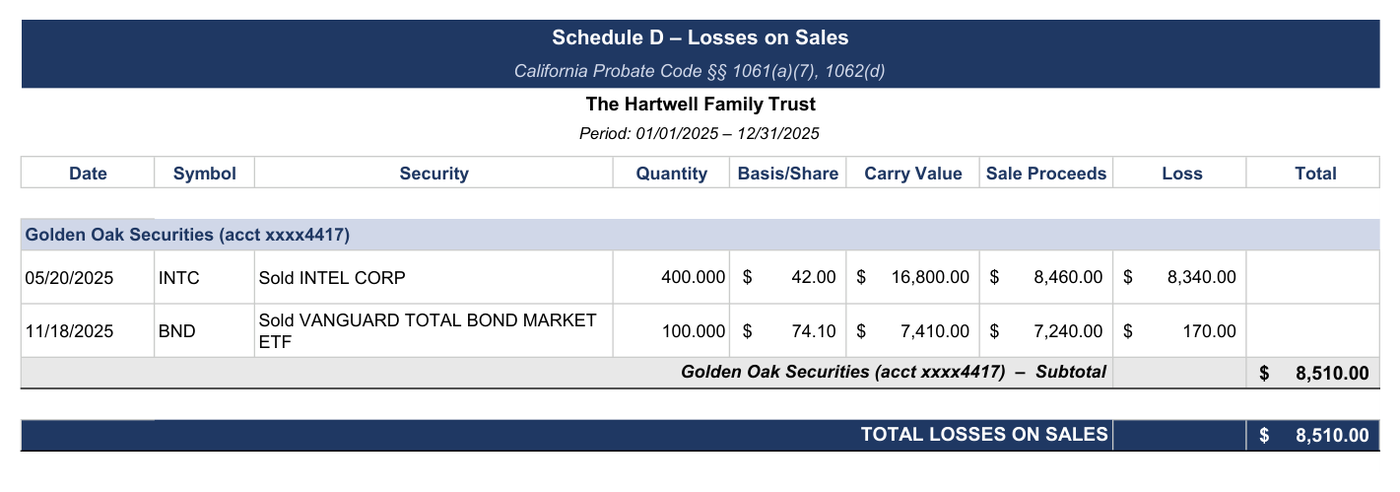
Schedule D: losses on sales
Each sale or other disposition that produced a loss, calculated from carry value (§§1061(a)(7), 1062(d)).
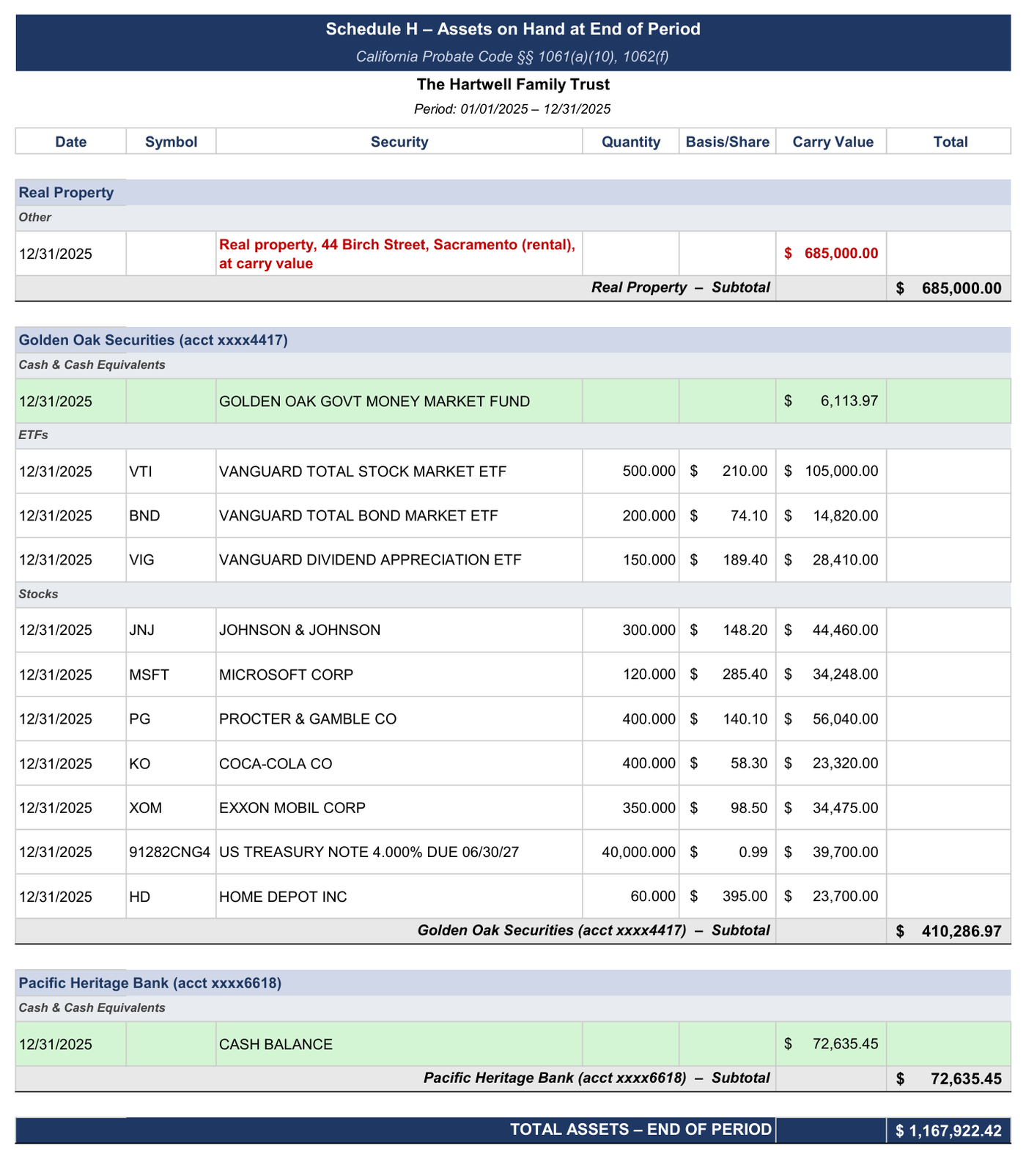
Schedule H: property on hand at the end
An itemized list of the property on hand at the close of the period, at carry value (§§1061(a)(10), 1062(f)). It becomes Schedule A of the next account.
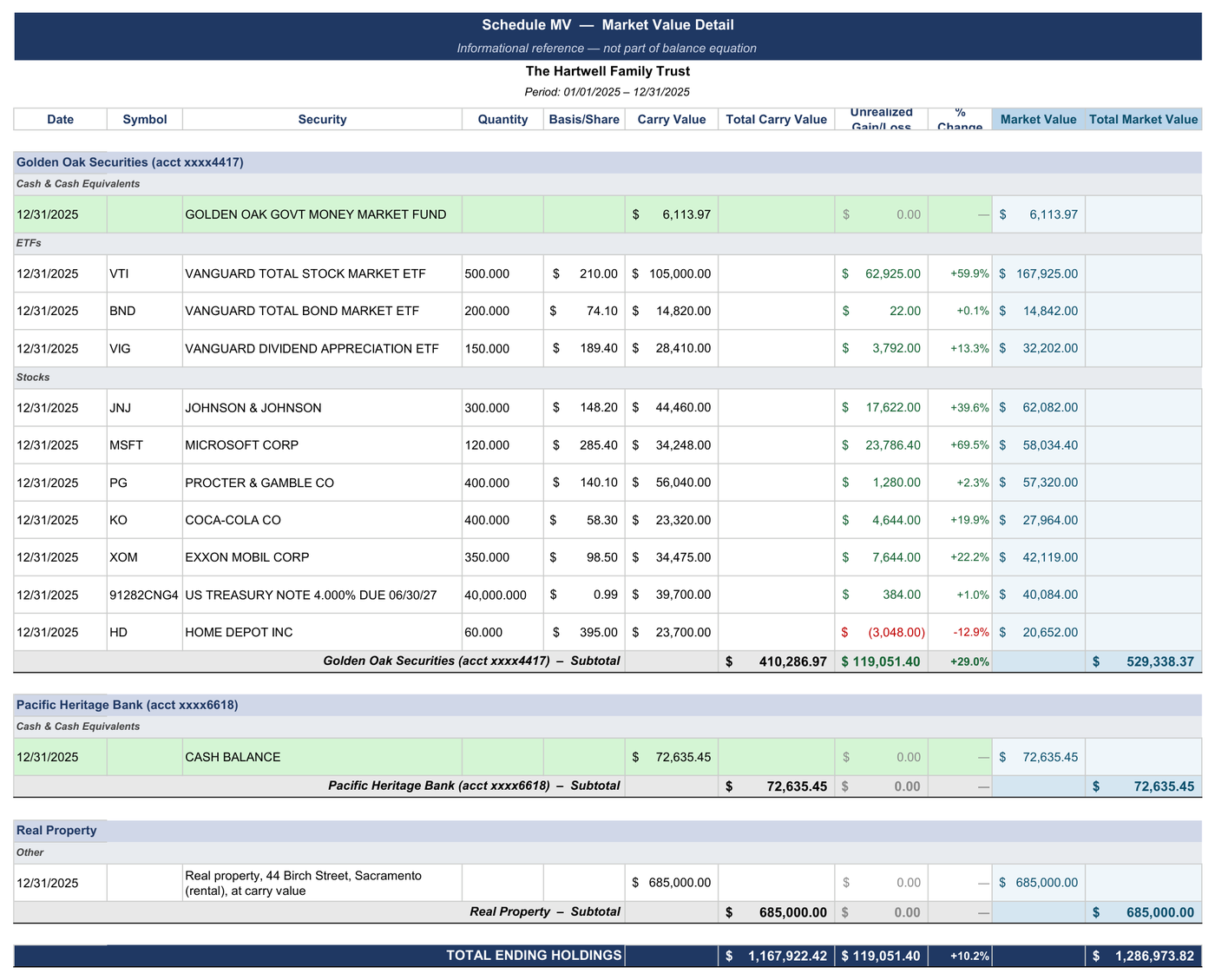
Market value at the end of the period
Each holding at carry value and at market value (§1063(a)). For reference; it is not part of the balance.
Allocation between principal and income
When there is an income beneficiary, each receipt and disbursement is allocated between principal and income (§1063(c)) under California’s Uniform Fiduciary Income and Principal Act (Prob. Code §§16320–16383).

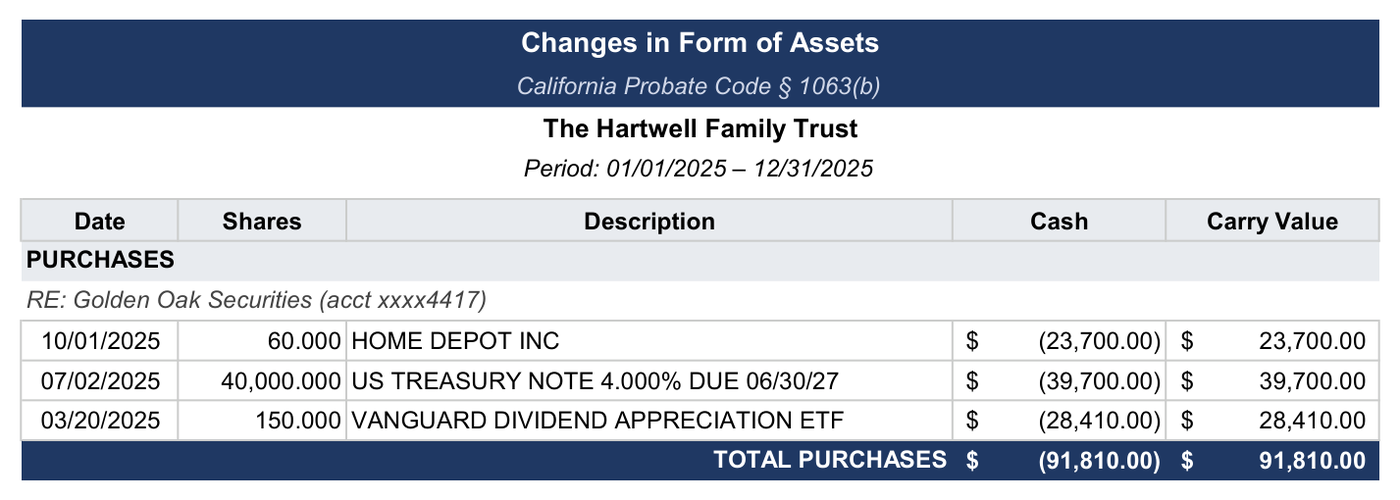
Changes in form of assets
Purchases and other changes in the form of assets during the period (§1063(b)).
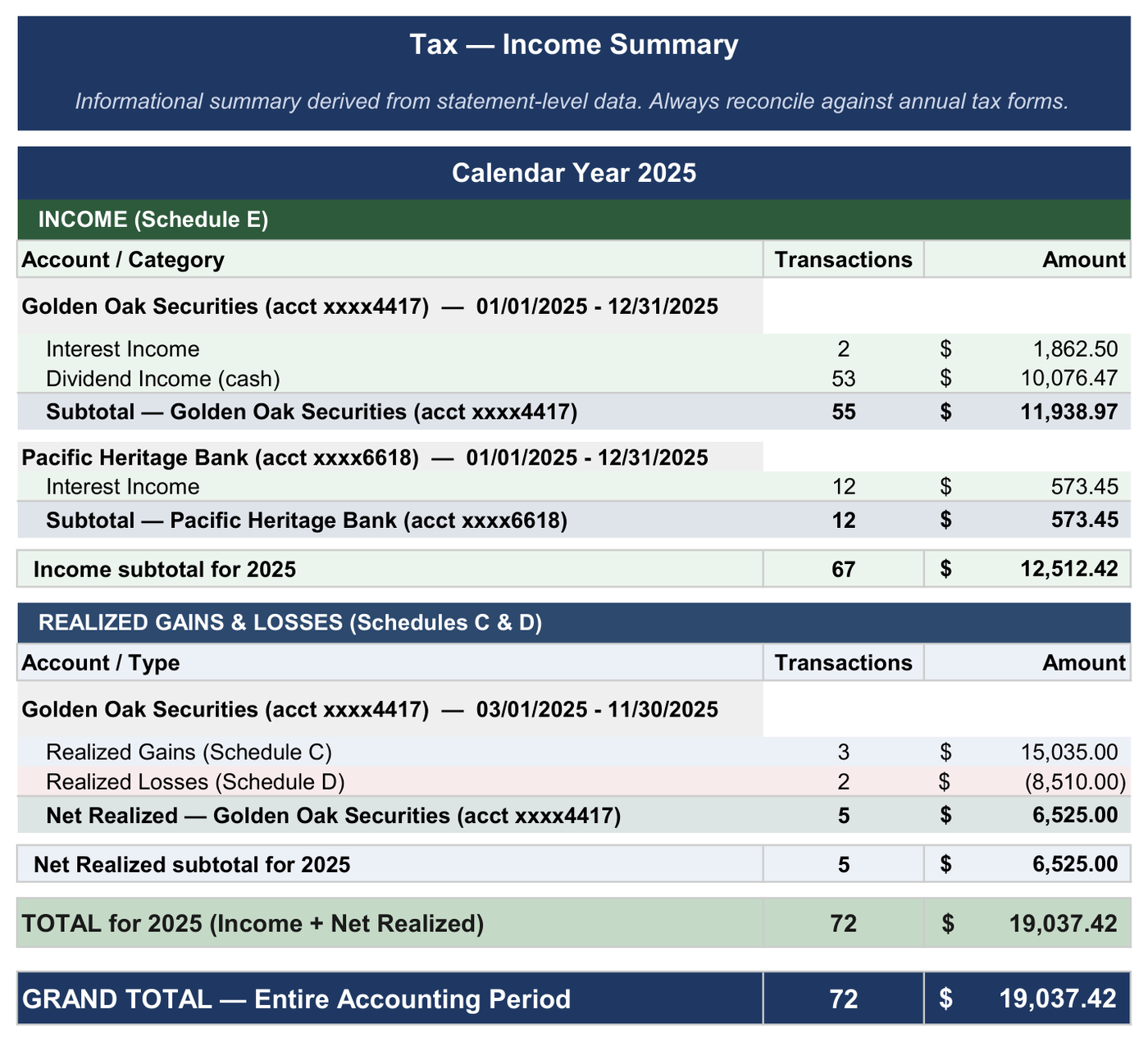
Tax summary for the CPA
Income and realized gains and losses by calendar year and account. For the fiduciary income tax return; not part of the accounting.
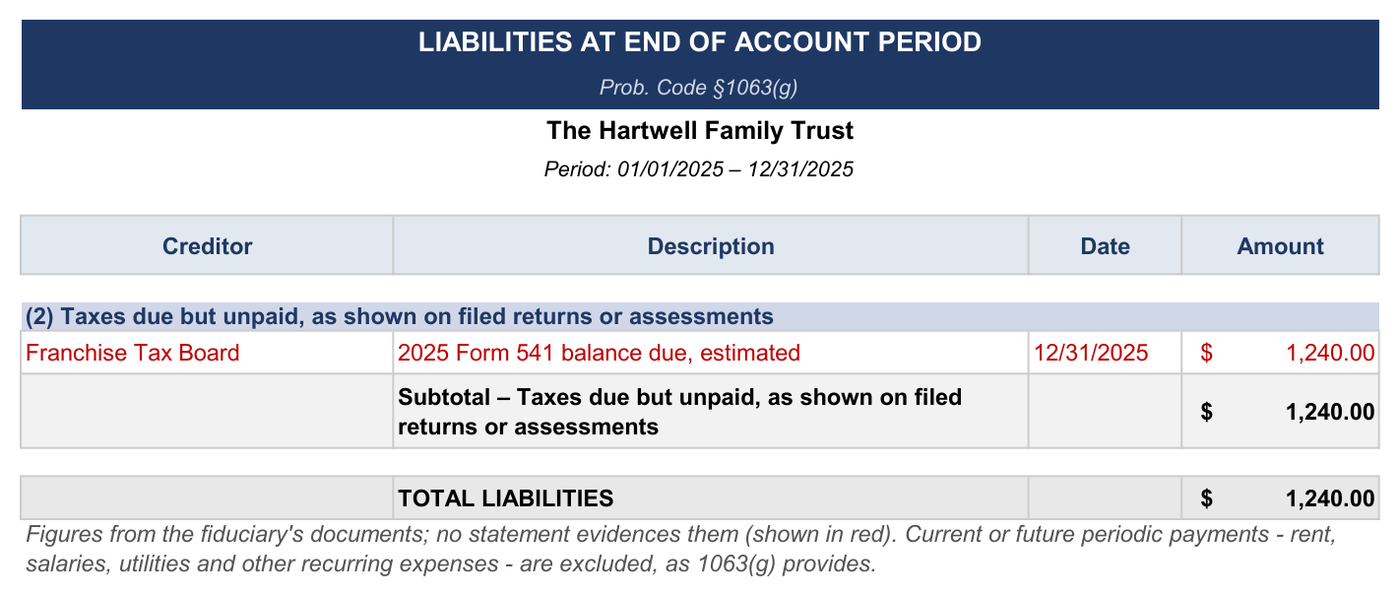
Liabilities
The liabilities of the trust or estate at the end of the period, such as liens, unpaid taxes and notes (§1063(g)).
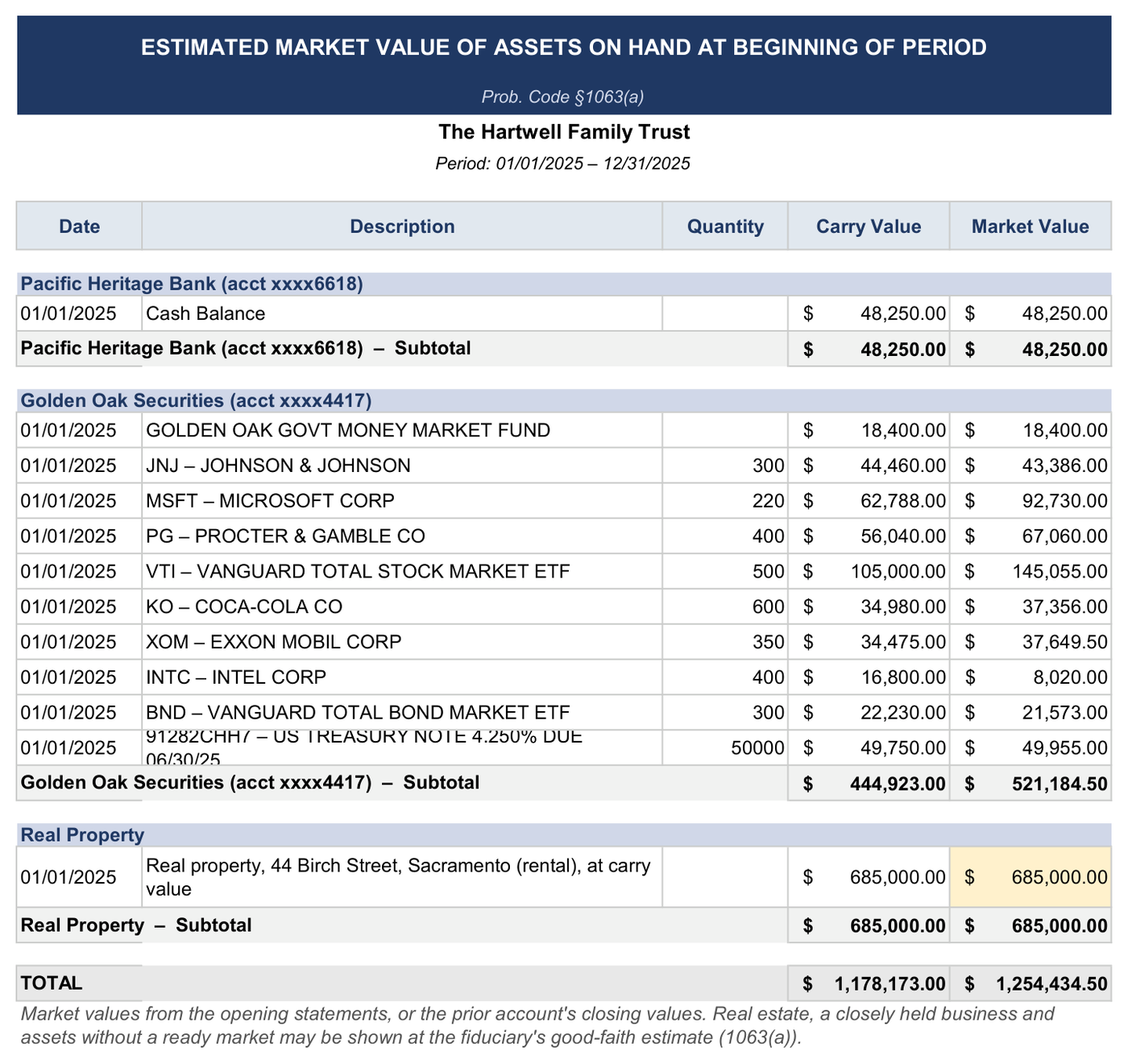
Market value at the beginning of the period
The same comparison as of the first day of the period, which §1063(a) requires for every account after the first.
Generate yours
Balanced generates an accounting of this kind from the fiduciary’s PDF bank and brokerage statements: transactions classified to their schedules, carry values tracked lot by lot, each account reconciled to its own statements, the summary balanced to the penny, and each entry cited to the statement and page from which it was drawn, delivered as one fully editable Excel workbook for review and verification. $699 per accounting.
Prefer to fill it in yourself? Use the free California trust accounting template.