
How the schedules fit together
A California court accounting for a trust or a probate estate opens with a summary in the form set out in Probate Code §1061(b): the property the fiduciary is charged with on one side, the credits on the other. Under §1061(c), total charges must equal total credits. Section 1062 then requires a supporting schedule behind each line of the summary, and §1063 adds further schedules when they apply.
The statutes do not assign letters to the schedules. The letters below are the ones Balanced uses; many practitioners use similar ones.
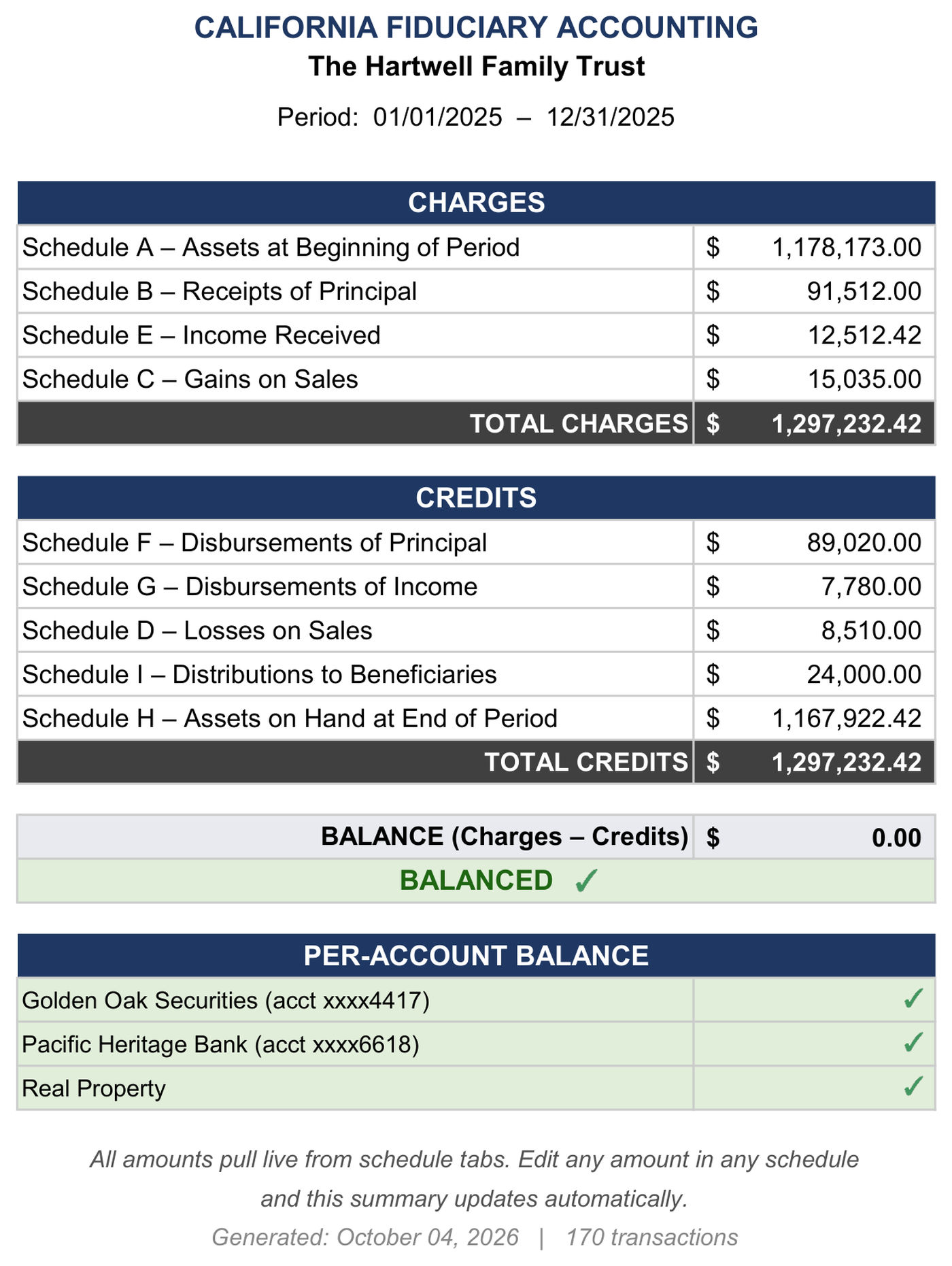
The summary of account (§1061)
The charges: property on hand at the beginning of the period (§1061(a)(1)), additional property received (§1061(a)(2)), receipts (§1061(a)(3)), net income from a trade or business (§1061(a)(4)) and gains on sales (§1061(a)(5)). The credits: disbursements (§1061(a)(6)), losses on sales (§1061(a)(7)), net loss from a trade or business (§1061(a)(8)), distributions (§1061(a)(9)) and property on hand at the end of the period, at carry value (§1061(a)(10)).
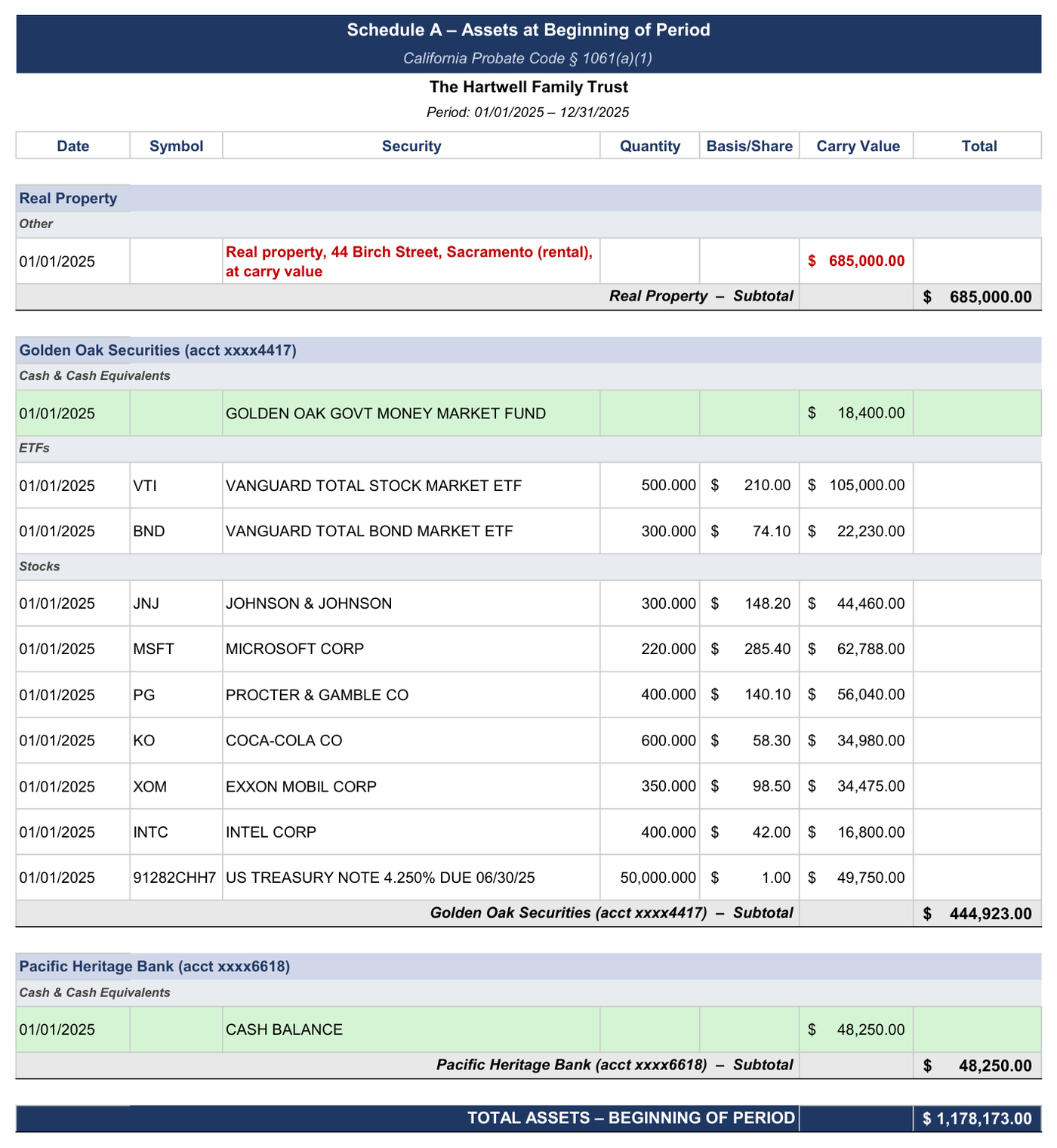
Schedule A: property on hand at the beginning (§1061(a)(1))
Every asset on hand on the first day of the period, at carry value. For a first account, that is the inventory; for a later account, it is the property on hand at the close of the prior account.
The court expects a first account’s opening figures to tie to the Inventory and Appraisal. When an Inventory and Appraisal is provided with the order, Balanced uses its values. Otherwise Balanced uses the statement values at the start of the period, and the fiduciary should reconcile them to the inventory.
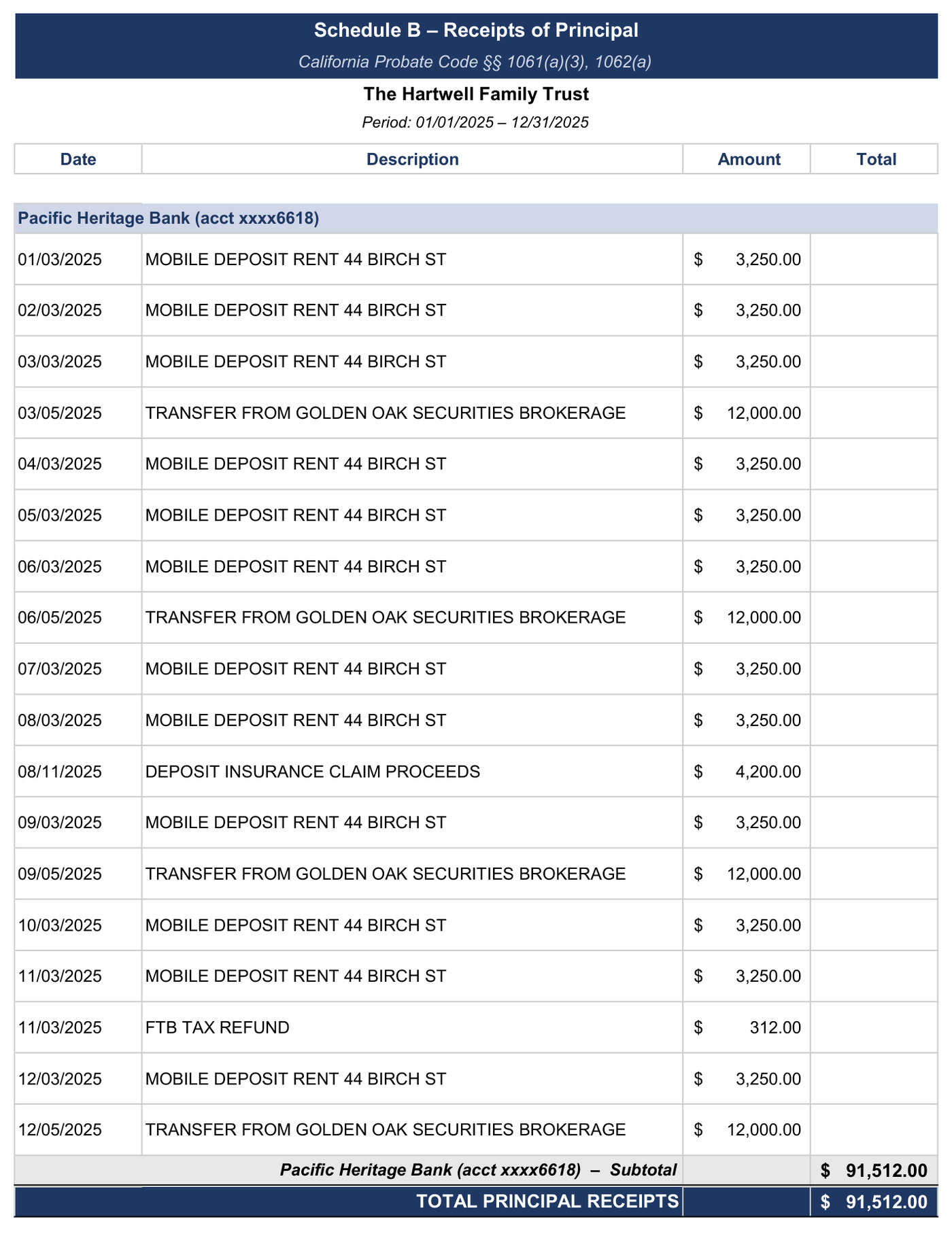
Schedules B and E: receipts (§§1061(a)(3), 1062(a))
Section 1062(a) requires each receipt to show its nature or purpose, its source and its date. Balanced lists receipts of principal on Schedule B and income received, such as dividends and interest, on Schedule E.
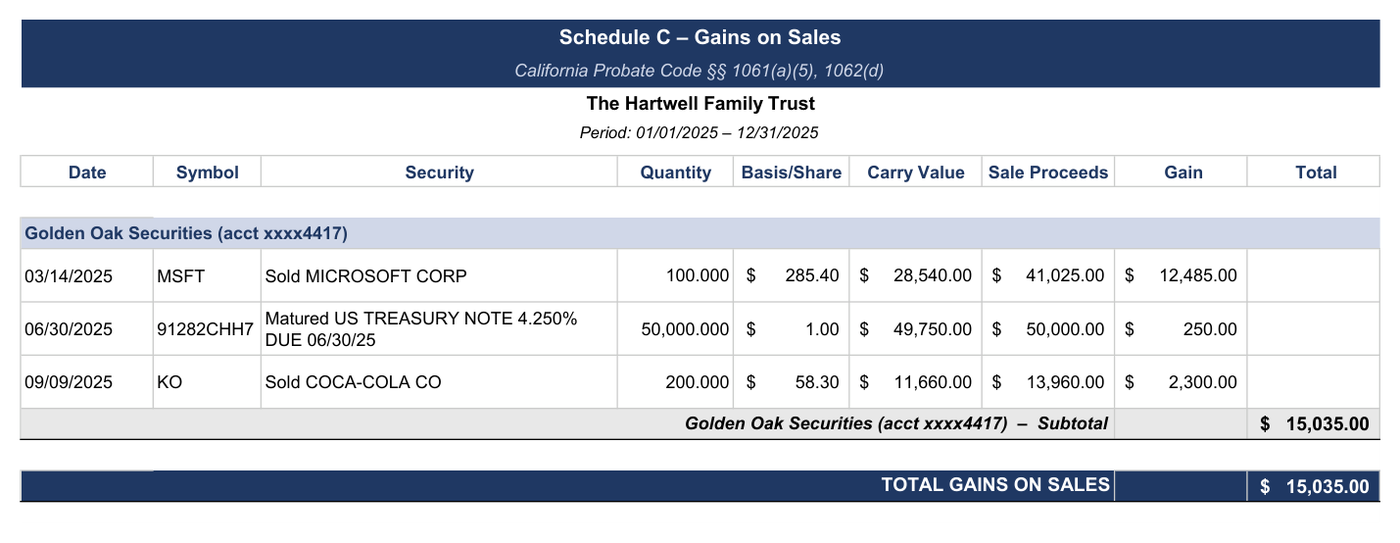
Schedules C and D: gains and losses on sales (§§1061(a)(5), (a)(7), 1062(d))
Section 1062(d) requires the calculation of each gain or loss on a sale or other disposition. Each is measured from carry value, not from a brokerage’s printed cost basis.
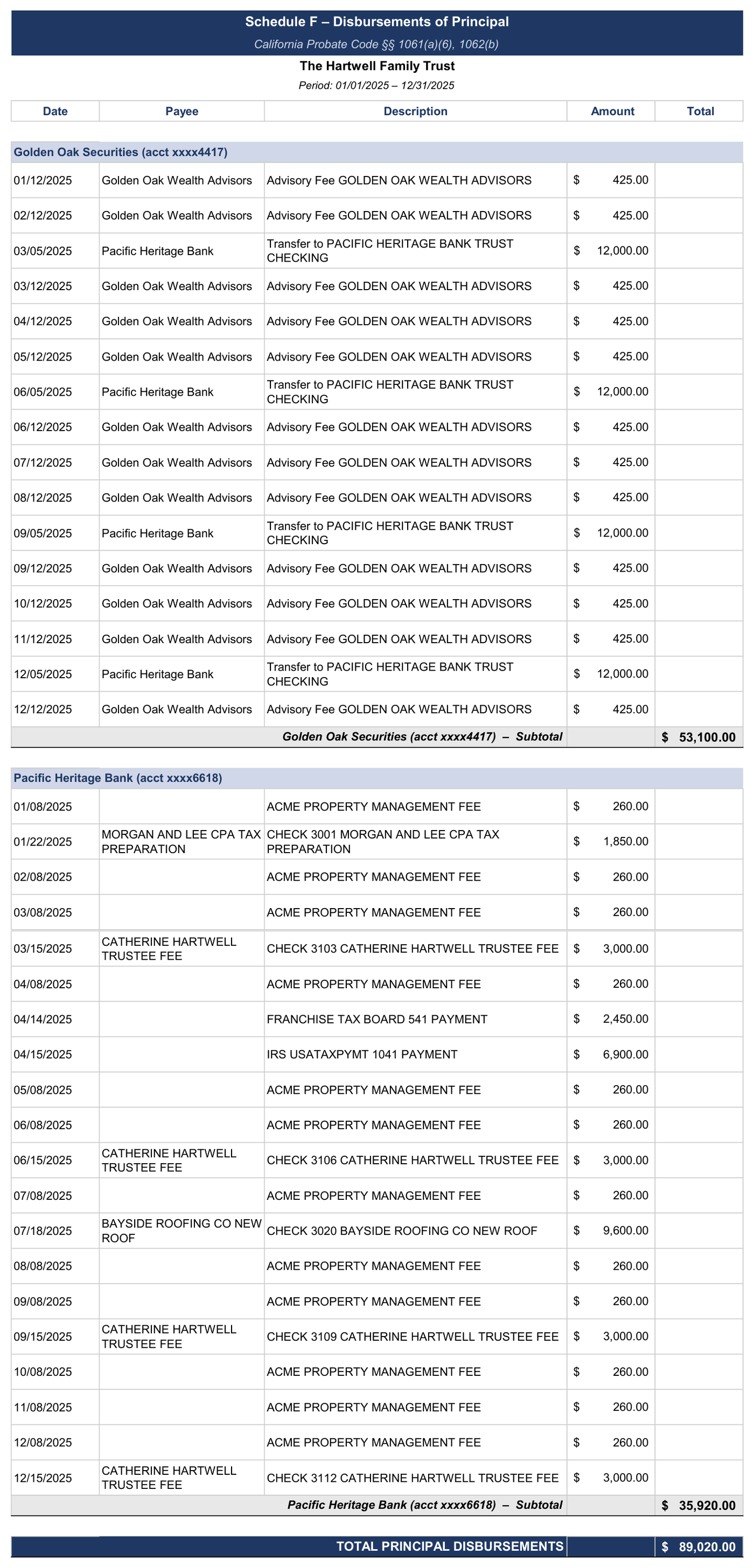
Schedules F and G: disbursements (§§1061(a)(6), 1062(b))
Section 1062(b) requires each disbursement to show its nature or purpose, the payee and the date. Balanced lists disbursements of principal on Schedule F and disbursements of income on Schedule G.
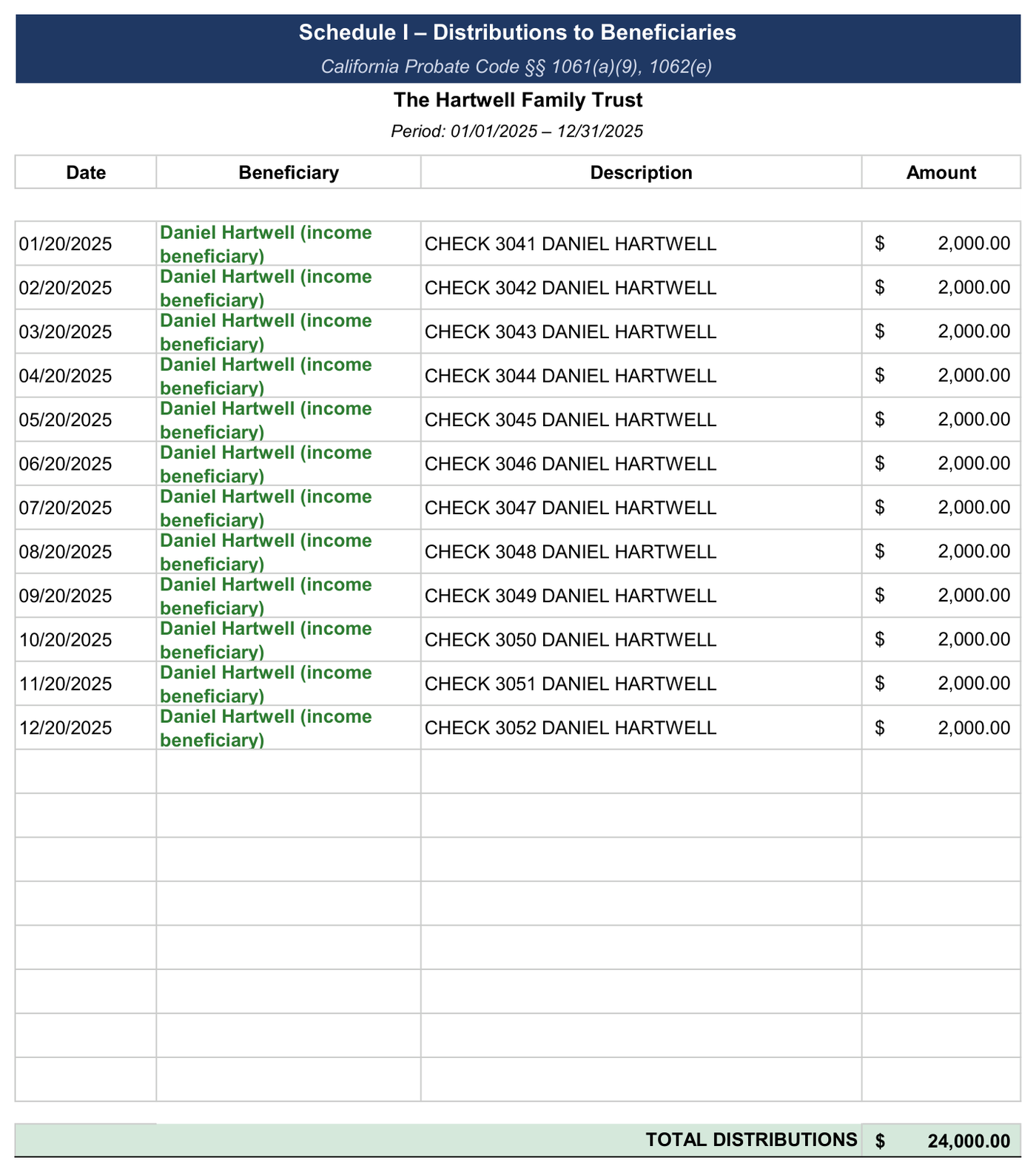
Schedule I: distributions (§§1061(a)(9), 1062(e))
Distributions of cash or property to beneficiaries, with the date and amount of each, and property distributed shown at carry value.
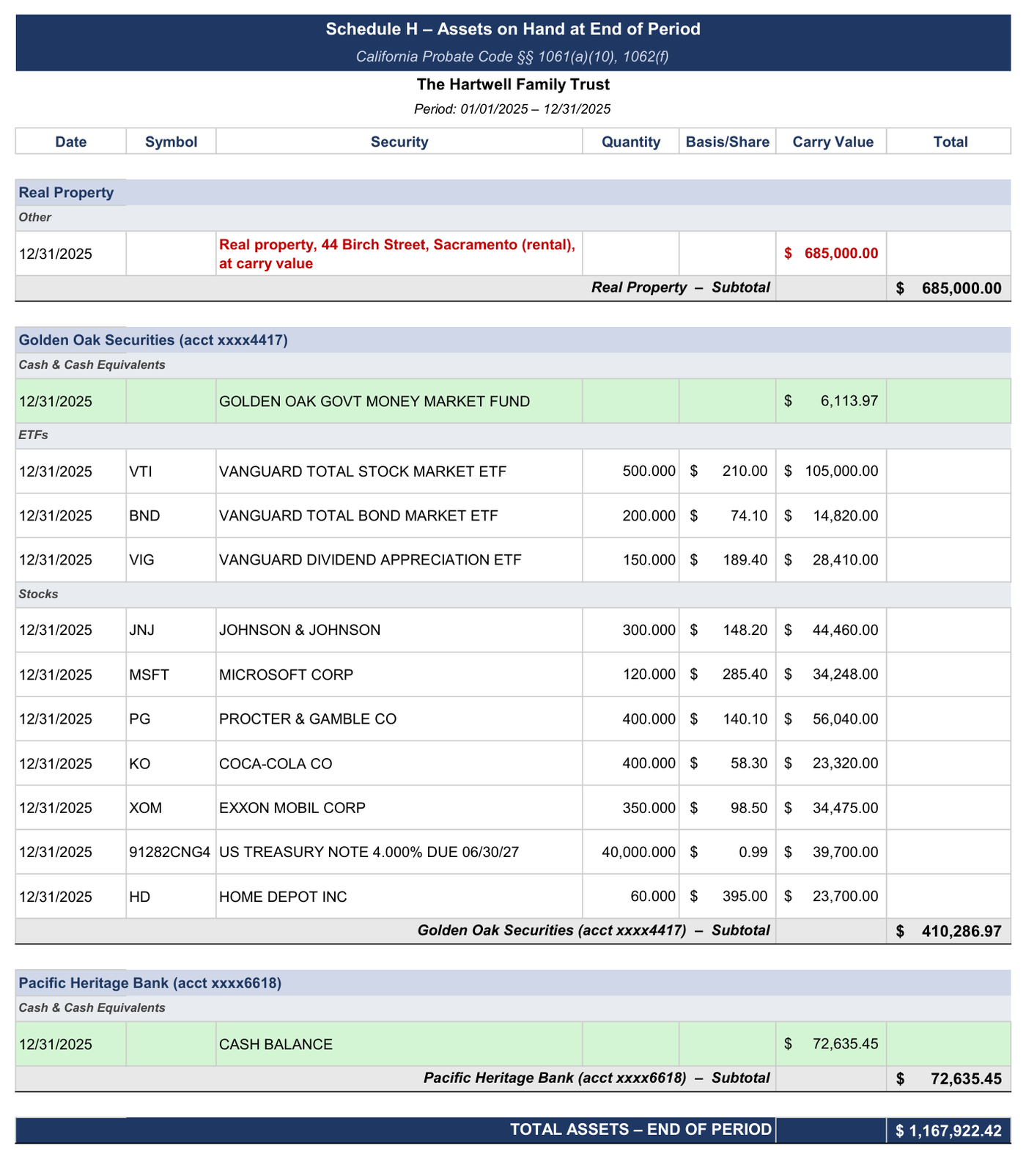
Schedule H: property on hand at the end (§§1061(a)(10), 1062(f))
An itemized list of the property on hand at the close of the period, each item at carry value. It becomes Schedule A of the next account.
Additional schedules under §1063
When they apply, §1063 adds schedules for: market value at the beginning and end of the period (§1063(a)); purchases and other changes in the form of assets (§1063(b)); the allocation of receipts and disbursements between principal and income when there are income beneficiaries (§1063(c)); specifically devised property (§1063(d)); interest on general pecuniary gifts (§1063(e)); a proposed distribution (§1063(f)); and liabilities (§1063(g)). A trade or business is reported net, supported by a schedule of its income and expenses (§1062(c)).

Complete examples and a template
See every schedule in context: a complete trust accounting example, a complete probate estate accounting example, and a free Excel template in this format.